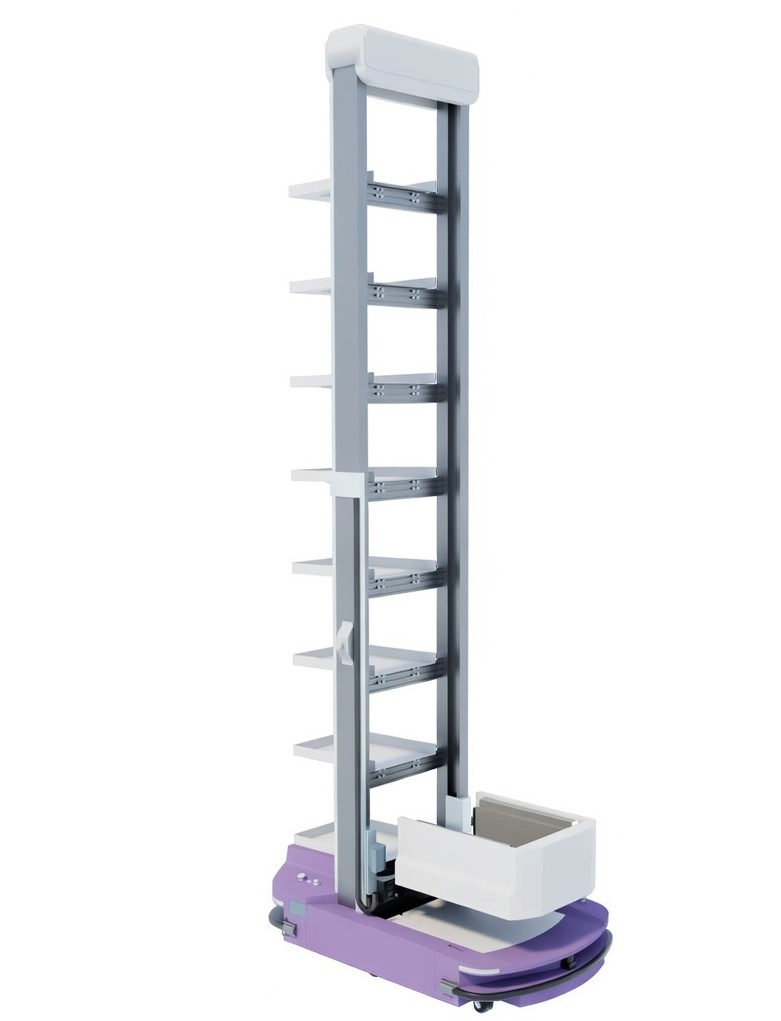
The material box AGV is an automated mobile robot specially designed for the handling of material box goods. It features high efficiency, accuracy and flexibility, and is widely used in scenarios such as warehousing and logistics, and intelligent manufacturing.
The material box AGV is an automated mobile robot specially designed for the handling of material box goods. It features high efficiency, accuracy and flexibility, and is widely used in scenarios such as warehousing and logistics, and intelligent manufacturing.
Compact in size and low in height, it is convenient to move through narrow aisles or shelves. Some models are narrow in width, making them suitable for dense storage environments. The back is equipped with a special load-bearing frame for the material box, and the loading and unloading of the material box can be achieved through actions such as lifting and translation. After reaching the target position, the position of the material box is located through visual recognition or sensors.
The clamping mechanism is linked with the docking equipment to achieve automatic conveying or lifting and material retrieval of the material box.
The Latent AGV material box type is a specialised automated mobile robot engineered for the efficient handling of material box goods. It delivers high efficiency, accuracy and flexibility, rendering it an ideal choice for demanding applications in warehousing and logistics as well as intelligent manufacturing. Its compact dimensions and low height profile enable seamless navigation through narrow aisles and beneath shelves, while certain narrow width variants are optimised for dense storage layouts. This design ensures reliable performance in space constrained environments typical of modern supply chains, where precise material flow is essential to maintain productivity and minimise downtime.
Key Design and Operational Features
Compact size combined with a low height profile supports effortless movement in confined warehouse aisles and shelving systems
Narrow width configuration available on selected models, making it particularly suitable for high density storage environments
Specialised load bearing frame positioned at the rear, purpose built to accommodate material boxes securely
Automated loading and unloading achieved through coordinated lifting and translational movements
Precise localisation of material boxes at the target position via advanced visual recognition or integrated sensor systems
Clamping mechanism that interfaces directly with docking equipment to facilitate fully automatic conveying, lifting and material retrieval
Technical Specifications
Navigation method: inertia plus QR code vision
Maximum load capacity: 50 kilograms
Walking speed: 1.5 metres per second
Battery life: greater than 1500 charge and discharge cycles
Goods specifications: 600 millimetres by 400 millimetres by 300 millimetres
Safety protection: laser obstacle avoidance and safety edge contact
Control mode: programmable logic controller system
Positioning accuracy: plus or minus 10 millimetres or plus or minus 1 degree
Benefits and Operational Implications
This Latent AGV material box type streamlines material handling processes by reducing manual intervention, thereby enhancing overall throughput and operational safety in high volume facilities. Its integration of inertial navigation with QR code vision provides consistent reliability even in dynamic warehouse settings, while the sensor driven positioning and automated docking capabilities minimise errors and support continuous workflow. In practice, such systems contribute to scalable automation strategies, allowing warehouses to adapt to fluctuating demand without compromising accuracy or safety standards. For edge case scenarios, such as exceptionally narrow aisles or dense racking configurations, the low profile and narrow width options ensure compatibility where traditional equipment might prove unsuitable.