

Australia’s e-commerce market surpassed A$60 billion in 2026, and growth shows no signs of slowing. Order volumes continue to rise, delivery windows are shrinking, and customers now expect fast, accurate fulfilment as standard.
Manual warehouse operations can no longer keep pace. The gap between modern customer expectations and traditional fulfilment methods is widening every quarter.
For Australian retailers and logistics providers still relying on labour-heavy processes, the math no longer works: too many orders, too few hands, and not enough time.
Warehouse automation has moved beyond experimentation. It is now a core operational strategy for businesses that want to scale efficiently and remain competitive.
SmartlogitecX operates at the centre of this shift, helping Australian businesses design and deploy warehouse automation solutions built for the speed, complexity, and scale of modern commerce.
How E-commerce Growth Is Reshaping Australian Logistics
The Post-Pandemic Shift in Shopping Habits
The COVID era didn’t just create a temporary spike in online shopping, it permanently reshaped consumer behaviour.
Australians who had never purchased groceries, furniture, or hardware online adopted digital channels out of necessity and never looked back.
Today, nearly three-quarters of Australian businesses generate revenue through digital channels. Order frequency has increased, product categories have expanded, and fulfilment volumes now exceed what pre-pandemic warehouse models were designed to handle.
This is not a seasonal surge. It is a structural shift in how Australians shop and warehouses must evolve to support it.
Why Delivery Speed Drives Customer Loyalty
Delivery speed is no longer a competitive advantage. It is a baseline expectation.
Research shows that 17% of consumers will abandon a brand after a single poor delivery experience. That statistic reframes warehouse efficiency as a revenue protection issue.
Every delayed order, mis-picked item, or packing bottleneck carries a direct cost in lost customers and reduced lifetime value.
The warehouse is no longer a back-office function. It is a frontline driver of customer loyalty and brand trust.
Why Manual Warehouse Operations Are Falling Behind
The Limits of Human-Only Picking and Packing
In large-scale warehouses, pickers often walk between 10 and 15 kilometres per shift. This travel time represents a major productivity loss.
Picking alone accounts for approximately 50–60% of total warehouse labour costs. As physical fatigue increases, so do error rates.
Mis-shipped orders lead to returns, rework, customer complaints, and margin erosion. At scale, these inefficiencies become unsustainable.
Labour Shortages and Workplace Safety Pressures
Recruiting and retaining warehouse labour has become one of the biggest challenges in Australian logistics.
Peak trading periods place further pressure on already stretched labour pools. At the same time, repetitive lifting and manual handling contribute to higher injury rates, absenteeism, and workers’ compensation claims.
Warehouse automation is not only a productivity strategy — it is a duty-of-care response to a tightening labour market.
Key Technologies Transforming Australian Warehouses
Autonomous Mobile Robots and Goods-to-Person Fulfilment
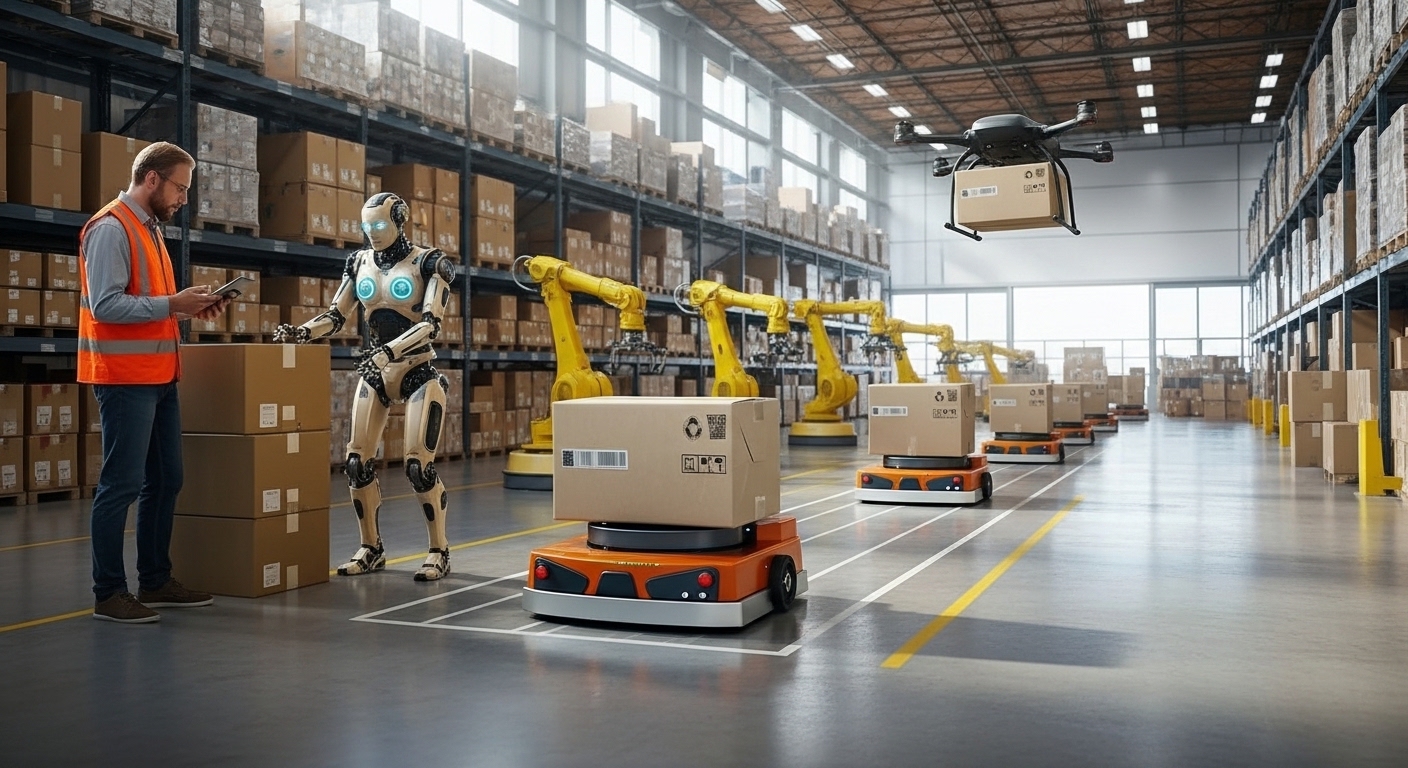
SmartlogitecX Autonomous Mobile Robots (AMRs) are one of the most flexible and scalable automation technologies available today.
Rather than workers travelling to inventory, AMRs bring goods directly to picking stations. Staff remain in one location while robots handle movement.
- Reduced walking time and labour fatigue
- Faster picking and order throughput
- Scalable capacity for peak demand periods
Unlike fixed conveyor systems, AMRs integrate easily into existing warehouse layouts and can be redeployed as operations evolve.
SmartlogitecX partners with AMR providers whose solutions are engineered for Australian warehouse environments and operational realities.
Intelligent Picking and Machine Vision Systems
Machine vision and assisted picking systems dramatically reduce error rates while increasing pick speed.
These systems identify, sort, and handle products with consistent accuracy, even in high-SKU, mixed-item environments.
Dynamic slotting further enhances efficiency by automatically positioning high-demand items closer to packing stations based on real-time order data.
The warehouse adapts continuously to demand, rather than relying on static layouts.
Warehouse Management Systems and Data Integration
Automation hardware is only as effective as the software controlling it.
SmartlogitecX modern Warehouse Management Systems (WMS) integrate robotics, inventory, and order data into a single operational view.
- Real-time inventory visibility
- Predictive demand forecasting
- End-to-end order tracking
With accurate data, every warehouse movement becomes measurable, optimisable, and accountable.
The Business Case for Warehouse Automation
Maximising Revenue Per Square Metre
Warehouse automation consistently delivers a 10–20% increase in revenue per square metre.
Automated storage and retrieval systems allow businesses to utilise vertical space, increasing capacity without expanding physical footprints.
In high-cost Australian industrial markets, this directly translates to lower occupancy costs and improved profitability.
Upskilling Staff Into Higher-Value Roles
Automation does not eliminate the workforce, it elevates it.
Repetitive manual tasks are replaced by roles focused on system oversight, maintenance, and performance optimisation.
Automation also shortens onboarding time, allowing new staff to become productive faster with intuitive interfaces.
SmartlogitecX supports businesses through this transition, aligning technology adoption with workforce strategy.
Industry Leaders Setting the Standard in Australia
Retail Giants Investing in Automated Fulfilment
Major Australian retailers including Woolworths, Coles, and Kogan have made significant investments in automated fulfilment centres.
These are not pilot projects. They represent long-term commitments to automation as the foundation of future retail operations.
As industry leaders standardise on automation, expectations across the supply chain rise.
DHL’s Global Robotics Commitment
DHL’s investment in deploying over 1,000 assisted picking robots globally, with Australia as a key beneficiary, demonstrates the scalability of warehouse automation.
The rollout proves that robotic fulfilment works across diverse warehouse sizes, product types, and volume profiles.
Frequently Asked Questions
What is warehouse automation?
Warehouse automation uses robotics, software, and data systems to automate storage, picking, packing, and dispatch processes.
How much does warehouse automation cost in Australia?
Costs vary by scale and solution type. Many Australian businesses achieve positive ROI within 18–36 months using modular, staged investments.
Can small and mid-sized businesses afford automation?
Yes. Scalable solutions allow businesses to automate targeted areas first and expand as volumes grow.
How does automation affect warehouse staff?
Most implementations result in redeployment rather than reduction, shifting staff into higher-value, safer roles.
What ROI can businesses expect?
Typical returns include improved revenue per square metre, reduced labour cost per order, faster fulfilment, and lower error rates.
Future-Proofing Australian Warehouses for What Comes Next
Consumer expectations will continue to rise. Order volumes will keep increasing. Labour availability will remain constrained.
Flexible, scalable warehouse automation is becoming the standard operating model for Australian fulfilment, not the exception.
Businesses that invest now are building resilient operations designed for the next decade of growth.
If your warehouse is already under pressure, the cost of inaction is growing every day.
SmartlogitecX helps Australian businesses audit bottlenecks, design practical automation roadmaps, and deploy solutions that deliver measurable results.
The time to act is now.