Reliable | Fast | Future-proof

3D Cube Storage Systems

3D Cube Storage Systems
  • Home
  • 3D Cube Storage System
All 3D Cube Storage

3D Cube Storage

The new energy stacker crane is a lifting and transportation equipment designed to…

Read More

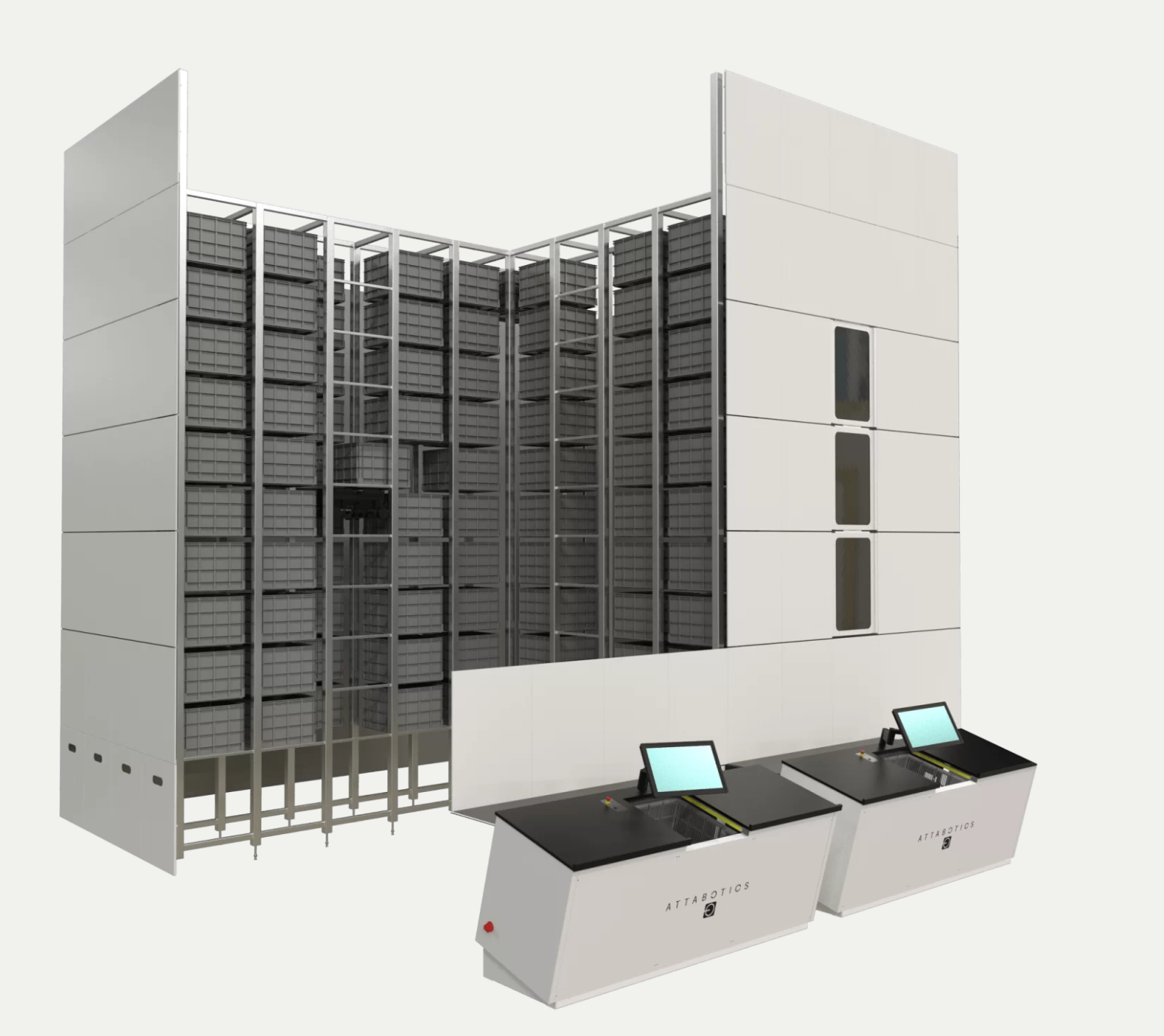
Attabotics 3D Cube Storage System

Goods-to-person automated storage and retrieval (cube ASRS)

1. System classification and architecture

System type: three dimensional cube automated storage and retrieval system (ASRS); goods-to-person order fulfilment.

  • Structure: self supporting vertical grid (“cube”) storing bins in a dense three dimensional array.
  • Robotics: a fleet of robots (Attabots) traverses the grid in all three axes — across the top, down the sides and through the interior.
  • Access model: every robot can reach every bin and every presentation station; each bin is directly accessible with no digging or re slotting.
  • Sequencing and sortation: performed within the structure, in the volume beneath the storage array (the “basement”), removing the need for external conveyor systems.
  • Presentation: stations are located on the perimeter and integrated into the structure geometry, so any robot can serve any station.
  • Redundancy: no single point of failure at robot level — a robot fault does not isolate stored inventory or a zone.

2. Robot (Attabot) specifications

Parameter

Specification

Travel

All three axes of the grid (horizontal, vertical and across the top)

Access

Every bin and every presentation station

Top speed

8.8 ft/s (approx. 2.68 m/s)

Maximum payload

99 lb including bin weight (approx. 45 kg)

Power source

Long life ultra capacitors

Charging

Recharged each cycle while climbing (no battery swap or dedicated charging downtime)

3. Storage structure and density

Parameter

Specification

Maximum build height

Up to approx. 40 ft (approx. 12.2 m) — see note on height figures

Footprint reduction

Up to 85% versus a manual pick from shelf layout

Bin retrieval time

Bin delivered to a presentation station within approx. 90 seconds of request

Slotting requirement

Performance independent of order structure; no fast-mover zone or Pareto curve required

Storage density

Class leading; every bin remains directly accessible despite high density

4. Throughput and presentation stations

Parameter

Specification

Rate per station (current)

More than 300 bins per hour to the operator

Rate per station (newer stations)

400 to 500 bins per hour

Station placement

Anywhere on the perimeter; integrated into the structure geometry

Throughput scaling

Increased by adding robots and presentation stations, without expanding the building footprint

5. Bin specifications

Two bin heights are available; both accept removable dividers for up to 16 compartments per bin.

Parameter

Medium bin

Tall bin

Outer dimensions (l x w x h)

24 x 24 x 11 in
(610 x 610 x 279 mm)

24 x 24 x 17 in
(610 x 610 x 432 mm)

Interior dimensions (l x w x h)

22 x 22 x 10 in
(559 x 559 x 254 mm)

22 x 22 x 16 in
(559 x 559 x 406 mm)

Empty weight

Approx. 9.7 lb (approx. 4.4 kg)

Approx. 9.7 lb (approx. 4.4 kg)

Maximum payload

99 lb incl. bin (approx. 45 kg)

99 lb incl. bin (approx. 45 kg)

Material

Polypropylene, UNIPOL 2135

Polypropylene, UNIPOL 2135

Dividers

Up to 16 compartments

Up to 16 compartments

6. Performance metrics

Metric

Figure

Space reduction

Up to 85% (versus manual pick from shelf)

Labour reduction

Up to 75%

Capital expenditure reduction

Up to 50%

Bin accessibility

100% (every robot reaches every bin)

Robot count vs competing approaches

Approx. 25% fewer robots

7. Deployment envelope and scalability

  • Installed range: from fewer than 5,000 bins to more than 190,000 bins per system.
  • Modular scaling: storage capacity and throughput scale independently — add bins to extend storage, add robots and stations to raise throughput.
  • Expansion impact: the system can be extended without significant disruption to ongoing operations.
  • Deployed sectors: luxury retail, general and B2B retail, ecommerce beauty, automotive, food service and general merchandise (North America).

8. Industries where Automated Storage Systems can be used

  • No external conveyor systems required; sequencing and sortation are internal to the structure.
  • Automatic sequencing of orders, including small orders requiring a set pack order.
  • Retrieval performance is independent of assortment profile, so no slotting optimisation is required to sustain it.
  • Ultra capacitor charging on each cycle avoids battery swap stations and associated downtime.
  • Robot level redundancy provides fault tolerance without loss of access to stored inventory.
Empower Your Business Through Technology

Benefits of Automation
for forward-thinking companies

When robots and automation are implemented in a business effectively, they don’t replace jobs. They augment them to drive greater productivity.

Smartlogitecx-slider-about