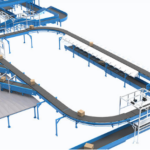

Automated cube storage systems, also known as cube ASRS, are compressing the warehouse into a dense robotic grid. For Australian operators wrestling with scarce land and stubborn labour shortages, the goods to person model promises a quieter, denser and far more flexible way to move stock.
By Daniel Hartwell, Senior Systems Engineer, SmartlogitecX
Key takeaways – Cube storage systems, or cube ASRS, replace warehouse aisles and racking with a dense three dimensional grid of bins that robots retrieve and bring to a worker, a model known as goods to person fulfilment. – They can condense the warehouse footprint by up to around 85 per cent and cut fulfilment labour substantially, redeploying people to higher value work rather than removing them. – The structure retrofits into an existing building without floor remediation and scales in stages, so it suits both new and established sites. – It earns its keep across ecommerce, grocery, third party logistics, dark stores, micro fulfilment and store within a store formats. – For Australian operators facing scarce industrial land and persistent labour shortages, density is the practical advantage that makes faster fulfilment affordable. |
Walk into a traditional distribution centre and the first thing you notice is the empty air. Racking climbs only so high, forklifts need wide aisles to turn, and pickers spend most of their shift walking rather than picking. For decades that was simply the cost of doing business. Then a different idea arrived, borrowed in part from the way ants build their colonies underground. Stop spreading goods across a vast floor and start stacking them into a dense cube that robots can climb.
That idea now has a name in the trade. The automated cube storage system, or cube ASRS, is quietly changing how Australian businesses think about fulfilment. Instead of aisles and shelves, picture a tightly packed grid of bins served by small robots that retrieve whatever is needed and bring it to a person at a workstation. The promise is simple to state and hard to ignore. Store far more in far less space, ask people to walk far less, and keep the whole operation moving around the clock.
What an automated cube storage system actually is
What the term actually means
So what exactly is a cube storage system in this context? At its simplest, it is a form of automated storage and retrieval system that swaps conventional racking and aisles for a three dimensional structure of stacked storage bins. Robots move across or through that structure, collect the bins that hold the ordered items, and deliver them to operators at picking stations. Because the goods travel to the person rather than the person walking to the goods, the category is described as goods to person fulfilment.
It is worth separating the warehouse meaning from the household one. Type the phrase into a search engine and you will mostly find flat pack shelving and cube organisers for the spare room. The industrial version shares only the word cube. Here the cube is a load bearing lattice that can rise several metres, hold tens of thousands of bins and process orders in seconds rather than minutes.
Why density sets the cube apart
The concept sits within a broader family of automation that warehouse engineers call ASRS. What makes the cube approach distinct is density. By removing aisles almost entirely and using the full height of a building, a cube system stores more units per square metre than nearly any alternative on the market. That density is the heart of its appeal, and the reason the technology has moved from curiosity to serious contender in the space of a few short years.
How a cube storage system works
Beneath the simplicity lies some genuinely clever engineering. A cube system has four working parts that operate as one.
The structure
The frame is a modular grid of vertical columns and horizontal rails, built to fit the shape of the building rather than forcing the building to fit it. It can work around pillars, follow awkward walls and slot into low or high ceilings. Storage bins sit nested inside the columns, packed so tightly that almost no space is wasted.
The robots
Small electric robots are the muscle of the system. Depending on the design, they either travel across the top of the grid and lower a gripper to lift bins, or they move freely in three dimensions inside the structure itself, climbing vertical and horizontal tracks to reach any location directly. The second approach gives direct access to every bin at any time, with no need to dig through layers to reach a buried item.
The workstations
When a robot delivers a bin, it arrives at a presentation station where an operator picks, packs or replenishes. These stations are designed so that any order can be completed at any point, and more can be added without halting the system. A clear touchscreen guides the worker, and built in safety features keep hands and machines apart.
The software
Tying it all together is the control software, the true brain of the operation. It sequences the robots, decides which bins to fetch and in what order, manages inventory in real time and talks to the wider warehouse management system through an integration layer. The best cube software is purpose built for one structure and nothing else, which is what lets it squeeze maximum throughput from the hardware. It is also designed to be augmentable, so the system bought today can grow and adapt as needs change. Crucially, there is no single point of failure. If one robot stops, the others carry on, and a faulty unit can be swapped out at ground level while the system keeps running.
Why density matters now: the Australian context
None of this would matter much if warehouse space were cheap and workers plentiful. In Australia, neither is true.
The cost of industrial land
Industrial land in the major logistics corridors of Sydney, Melbourne and Brisbane has been among the most sought after in the world in recent years, with vacancy rates pushed to record lows and rents climbing accordingly. Every square metre a business occupies carries a rising price, and finding a larger shed near the customers you serve has become both expensive and slow. When you can store the same volume of stock in a fraction of the footprint, a cube system starts to look less like a luxury and more like a hedge against the property market.
A tight labour market
Labour tells a similar story. Warehouses across the country have struggled to recruit and retain pickers, particularly through the peak summer trading months. The work is physical, repetitive and hard to staff reliably. A model that asks people to walk less and lets them focus on the parts of the job that genuinely need human judgement is not about removing workers. It is about redeploying them to higher value tasks and easing the strain of jobs that machines simply do better.
Rising customer expectations
Then there is the customer. Australians have grown used to fast delivery, wide ranges and next day expectations, even across a continent of enormous distances. Meeting that demand from a sprawling manual warehouse is increasingly difficult. Compress the operation, place it closer to where people live, and the same building can support far quicker promises. Density, in other words, is not an end in itself. It is what makes modern fulfilment possible on Australian terms.
Coping with peaks and returns
Peak trading sharpens every one of these pressures. The weeks around the November sales and Christmas can double or triple order volumes, and a manual operation copes only by throwing more casual staff at the problem, assuming it can find them at all. An automated cube system absorbs the surge differently, by running its existing robots harder and adding workstations rather than bodies. Reverse logistics, the unglamorous business of processing returns, benefits in the same way, since items can be inducted straight back into the grid at the very stations used to pick them.
Cube storage versus racking and other forms of automation
How does the cube stack up against the alternatives? The honest answer is that it wins decisively on some measures and loses on others, and any serious buyer should understand the difference before signing anything.
Against traditional racking
Compared with conventional selective racking, the contrast is stark. Racking is cheap to install and flexible, but it wastes vertical space, demands wide aisles and ties throughput to how fast people can walk. A cube system reverses all three, trading a higher upfront cost for dramatic gains in density and speed.
Against other automation
Against other forms of automation the picture is more nuanced. Vertical lift modules and carousels, two long established ASRS formats, suit operations with a modest number of fast moving lines and limited floor area. They are simpler and often cheaper, but they cannot match the cube for sheer storage density or for handling a very large and varied range of products. Pallet based automated systems, by contrast, excel at moving full pallets but are overkill for the small item, high order world of ecommerce. The table below summarises where each option tends to fit.
| Approach | Storage density | Throughput | Best suited to |
| Selective racking | Low | Low to medium | Lower volume, lower cost operations |
| Vertical lift module or carousel | Medium | Medium | A few fast moving lines in a small footprint |
| Pallet ASRS | Medium | Medium to high | Full pallet movement |
| Cube ASRS (goods to person) | Very high | High | High SKU count, high order volume, tight space |
The cube is not a universal answer. For a small operation with simple needs it can be more system than the job requires. But for businesses fighting for both space and speed, few approaches come close.
The benefits operators are chasing
Strip away the engineering and the appeal comes down to a handful of outcomes that operators talk about again and again.
Space, or a smaller building
Vendors and early adopters report footprint reductions of up to around 85 per cent against a comparable manual warehouse, freeing floor area for other uses or removing the need to lease a larger building altogether. Treated purely as a property decision, that saving alone can justify the investment.
Labour redeployed, not removed
By cutting out the walking that dominates manual picking, cube systems can reduce the labour required for fulfilment substantially, with some operators citing figures in the region of three quarters. The point worth repeating is that this is labour liberation rather than replacement. People move to roles that reward attention, dexterity and decision making, while the machines absorb the monotony.
Speed and uptime
Because robots fetch bins in parallel and the software optimises every move, orders can be retrieved in seconds, and the absence of any single point of failure means the operation keeps running even when an individual robot is down. Many operators report the highest uptime of any cube based system they have run.
Accuracy and the data trail
Accuracy is the benefit operators value most. Manual picking carries an inevitable rate of error, with the wrong item or the wrong quantity slipping through, and every mistake costs money to put right and goodwill to absorb. Because the cube presents the correct bin to the operator and the software records every movement, error rates fall sharply, and the resulting data trail makes stocktakes and cycle counts far less painful than the clipboard rituals they replace.
Built to last
There is a longer view too. The strongest platforms are built to last and to adapt, so the structure and software bought today can scale and change as the business does, rather than ageing into obsolescence. And because the systems are compact and electrically efficient, they sit more comfortably within the sustainability goals that more Australian boards now take seriously. It is a quieter kind of growth, one that respects the limits of land and energy rather than sprawling ever outward.
Where it fits
One of the quiet strengths of the cube approach is how readily it adapts. The structure is built to suit your fulfilment space rather than forcing the space to suit it, whatever its dimensions and whatever you handle, which makes it close to universally deployable. It earns its keep across ecommerce, where each order is a handful of small items, and across grocery and online grocery, where it copes with chilled conditions and a punishing mix of product sizes. The same qualities suit apparel, with its endless variants of size and colour, regulated categories such as health and pharmaceutical lines where traceability is not optional, and third party logistics providers juggling many clients under one roof. Beyond the industry labels, though, Australian operators tend to reach for it in five recurring scenarios.
Retrofitting an existing warehouse
The structure is designed to drop into a warehouse you already occupy, whatever its dimensions. It can be installed without floor remediation and without extending the building, then scaled in step with the business as it grows. Viewed through a property lens, the spend is also a real estate decision, because condensing the fulfilment footprint by as much as 85 per cent frees up floor space for other uses.
Fitting out a new warehouse
If you are investing in a new facility, a cube system helps you optimise the layout, the operating costs and the daily running of the site from day one. Cutting the space required by up to 85 per cent leaves room to spare, while the purpose built software that drives the structure is endlessly augmentable, so the operating system managing your workflows and SKUs stays current well into the future rather than dating the moment it is switched on.
Running a dark store
A dark store exists purely to fulfil online orders, and the cube offers a cost effective way to reach more customers from one. It delivers strong throughput and keeps a wide range of SKUs available at once. Because the design is fully three dimensional, the robots can reach any bin directly without digging through layers, which removes single points of failure and keeps the system running whatever the day throws at it.
Standing up micro fulfilment
Setting up a smaller automated warehouse close to demand can cut fulfilment times dramatically. The cube offers the highest solution density of any ASRS on the market, so you can process more orders of greater complexity in the least possible space. It will fit almost anywhere it is needed, whether in a city centre, a shopping centre or somewhere further out.
Operating a store within a store
Running a store within a store brings its own headaches, and density answers most of them. The high density of the cube lets you store and process far more in far less space, with less labour, and the structure can be configured to fit even a modest back of house area. The robots take on the heavy lifting, turning space that once earned nothing into an engine for online orders.
What they cost and how to think about return
The question every operator asks eventually is what it costs. There is no single answer, and any vendor who offers one without first understanding your operation should be treated with caution.
What drives the price
Pricing depends on the number of bins, robots and workstations, the height and footprint of the structure, and the depth of software integration required. A compact micro fulfilment installation sits at one end of the scale and a large multi station distribution centre at the other, with a wide gap between them. As a rule the investment is significant, which is why the decision belongs in the boardroom as much as in the warehouse.
Framing the return
What changes the calculation is how the return is framed. The savings are not only operational, in labour and throughput, but also in property, because freeing up to 85 per cent of floor space is effectively a real estate decision in disguise. Many operators now model the system across its full working life, weighing reduced space, lower labour intensity and higher uptime against the upfront outlay. Flexible commercial models, including arrangements that spread the cost or tie it to usage, are also putting the technology within reach of medium sized businesses that once assumed automation belonged only to the giants.
Choosing and implementing in an Australian operation
For those weighing a move, a few questions matter more than the brochure figures.
Stock and order volumes
Start with your stock. The profile of your SKUs, how many you carry and how quickly they move, will determine whether a cube system fits and how it should be configured. Consider your order volumes, including the peaks, since a system sized for an average day will buckle on the busiest one.
The building
Then look at the building. Ceiling height and floor loading shape what is possible, and Australian operators should pay close attention to temperature and humidity, since a system destined for chilled food has very different requirements from one handling apparel. Established cube platforms typically operate across ambient and chilled ranges, but the details deserve scrutiny.
Integration and the vendor
Integration is the quiet make or break. A cube system has to talk to your existing warehouse management software, so a flexible integration layer and a clear plan for connectivity are essential. Finally, weigh the vendor itself, its support presence in Australia and its track record, because a structure expected to last twenty years is only as good as the partner standing behind it.
The bigger shift
Step back from the bins and robots and a larger pattern emerges. Fulfilment is being reimagined as an ecosystem of intelligent spaces that sit closer to customers, run with less waste and bend to meet demand rather than breaking under it. The cube is one expression of a broader ambition, to transform the flow of goods so that commerce can move in step with both people’s needs and the limits of the natural world.
For Australian businesses hemmed in by scarce land and scarcer labour, that is not a distant vision. It is a practical answer to a present problem, and one that a growing number of warehouses will be built around in the years ahead.
Frequently asked questions
What is an automated cube storage system?
It is a type of automated storage and retrieval system that replaces traditional aisles and racking with a dense three dimensional grid of stacked bins. Robots retrieve the bins and bring them to an operator at a workstation, a model known as goods to person fulfilment.
Is a cube storage system the same as an ASRS?
A cube system is one kind of ASRS. The broader ASRS family also includes vertical lift modules, carousels and pallet based systems. What sets the cube apart is its very high storage density and its use of robots moving across or within a stacked grid of bins.
How much warehouse space can a cube storage system save?
Vendors and early adopters report footprint reductions of up to around 85 per cent compared with a manual warehouse storing the same volume, although the exact saving depends on your product range, your building and the configuration chosen.
What does goods to person mean?
Goods to person describes a fulfilment model where stock is brought to a stationary worker rather than the worker walking to the stock. It removes most of the walking from picking, which improves speed and accuracy and makes for a far less tiring working day.
How fast can a cube storage system retrieve an order?
Because robots work in parallel and the software optimises every move, many systems retrieve a stored item within seconds. Actual throughput depends on the number of robots and workstations and the way the structure is designed.
Can a cube storage system be installed in an existing warehouse?
Yes. One of the technology’s real strengths is that the structure can be shaped to fit an existing building, working around columns and walls, usually without major structural work or floor remediation. It can also be scaled up in stages as the business grows.
How much does a cube storage system cost in Australia?
There is no fixed price. Cost depends on the number of bins, robots and workstations, the size of the structure and the integration required. Installations range from compact micro fulfilment setups to large distribution centres, so pricing is always quoted to the specific operation.
Will a cube storage system replace warehouse workers?
The aim is redeployment rather than replacement. By removing repetitive walking, the system frees people for tasks that need judgement, dexterity and attention. Many operators keep their teams and simply shift them to higher value roles.
What happens if a robot breaks down?
Cube systems are built with no single point of failure. If one robot stops, the others continue working, and a faulty unit can usually be removed and serviced at ground level while the rest of the system keeps running.
What industries use cube storage systems?
The technology is industry agnostic. It is used across ecommerce, retail, grocery and online grocery, third party logistics, manufacturing and even defence logistics, anywhere stock must be stored densely and orders fulfilled quickly.
Can cube storage systems handle chilled or frozen goods?
Many platforms operate across ambient and chilled environments, which makes them well suited to grocery and food distribution. Temperature and humidity tolerances vary by system, so confirm the operating range with the vendor before committing.
How tall can a cube storage system be built?
Heights vary by platform and by building, with many systems reaching around nine to twelve metres. The structure is designed to use the full height available, which is a large part of how it achieves such high storage density.
Is a cube storage system suitable for a small business?
It can be, particularly through compact micro fulfilment formats and flexible commercial models that spread the cost or tie it to usage. For very simple, low volume operations, though, traditional racking may still be the more sensible choice.