
How mid market distribution centres can scale throughput without betting the business on a single, irreversible installation.
Walk onto the floor of almost any growing distribution centre today and you will hear the same complaint from the people running it. Orders are climbing, the labour market is thin, and the building was never designed for the volume now passing through it. The instinct, encouraged by glossy vendor brochures, is to picture a fully robotic facility humming along with no human in sight. The reality of good automation is far less dramatic and far more useful.
For most operators the question is not whether to automate but how to do it without halting the business in the process. A poorly sequenced project can sink capital into hardware that the warehouse outgrows in two years, or worse, bring picking to a standstill during the very weeks that matter most. This guide takes a deliberately pragmatic line. It treats warehouse automation as a spectrum of modular choices rather than a single, all or nothing leap, and it focuses on the decisions that mid market logistics managers actually face when they sit down to plan a transition.
What warehouse automation actually means
| DEFINITION
Warehouse automation is the process of replacing repetitive manual tasks such as inventory tracking, materials transport and order picking with digitised software and robotic systems. By pairing physical hardware like autonomous mobile robots with orchestration software such as a warehouse execution system, an operation can lift picking speed, cut order errors and reduce labour related operating costs. |
It helps to separate the term into two halves that behave very differently. The first half is physical: the robots, vehicles and structures that move goods around the building. The second half is digital: the software brain that decides what should move, when, and in what sequence. A common and expensive mistake is to buy the physical half while neglecting the digital half. Hardware without a coordinating intelligence is just expensive machinery sitting on a floor, and the operators who have lived through failed projects will tell you that software accounts for the majority of the difficulty. The robots are, comparatively, the easy part.
Decoding the technology: physical versus digital systems
Physical automation: the robotics and hardware layer
The physical category covers everything that physically handles or transports inventory. Automated guided vehicles, usually shortened to AGVs, follow fixed routes marked out by magnetic tape, embedded wires or laser targets. They are dependable workhorses for repeatable, heavy haulage, but they expect the world around them to stay still, and they stop when something blocks the path.
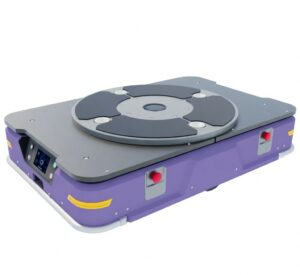
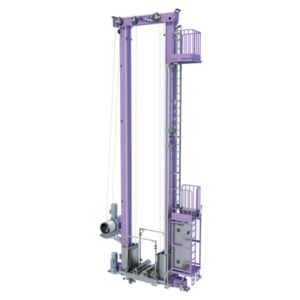
Autonomous mobile robots, or AMRs, are the more flexible cousin. Rather than following a painted line, they build a virtual map of the building using LiDAR and onboard vision, then plan their own routes in real time. When a forklift or a person crosses their path, they steer around the obstruction and keep working. Because their map is virtual, adding more units or changing the layout is a software exercise rather than a construction job. Alongside these you will find automated storage and retrieval systems, known as AS/RS, which use cranes or shuttles to stack and retrieve goods at high density up the vertical face of the building. Rounding out the category are collaborative robots, or cobots, designed to work safely beside people, and the fixed conveyor and sortation systems that have been the backbone of large facilities for decades.
Digital automation: the software brain
The digital layer is where modern automation earns its keep, and it sits in three tiers that are easy to confuse. A warehouse management system, or WMS, governs inventory: what you hold, where it sits and what needs to ship. Beneath that, a warehouse control system, or WCS, talks directly to the machines and routes physical tasks to the right device. Sitting across both is the warehouse execution system, or WES, the dynamic orchestration layer that balances workloads between robotic fleets and human pickers minute by minute, rerouting work the moment a bottleneck appears. Increasingly this layer is augmented by AI driven forecasting and by digital twins, virtual replicas of the building that let planners test a new layout in simulation before a single shelf is moved.
Comparing the physical transport options
| Technology | Navigation | Installation flexibility | Scalability | Safety profile |
| AGV | Magnetic tape, wires or laser targets | Low, needs dedicated pathways | Medium, easy to add units but hard to reroute | Obstacle detection, restricted lanes |
| AMR | LiDAR, SLAM, onboard vision | High, virtual mapping with no floor edits | Excellent, units added via cloud fleet software | Active collision avoidance, safe around people |
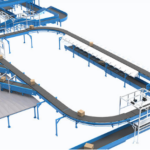
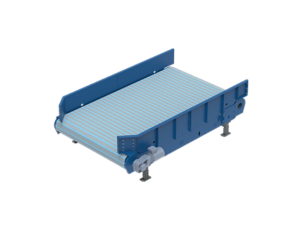
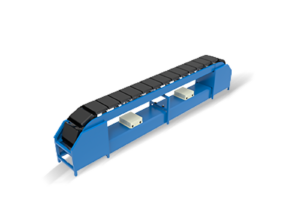
| Fixed conveyor | Mechanical rollers and drive belts | None, bolted to the floor | Poor, physical dismantling required to expand | Mechanical stops and guardrails |
Table 1. Where each transport technology fits, and where it does not.
The business case: measuring the return
Logistics managers do not buy robots for their own sake; they buy throughput, accuracy and resilience. The most immediate gain comes from collapsing the time pickers spend walking. In a manual operation, staff can spend more than half their shift simply moving between locations. Goods to person fulfilment, where a robotic system delivers the storage container directly to a stationary worker, removes most of that wasted travel and lets the same headcount process far more orders.
Accuracy improves in parallel. When scanning, RFID tracking and a smart WMS record every movement automatically, the human data entry errors that quietly erode customer trust largely disappear, and stock counts edge towards near perfect reliability. Then there is safety and retention. Shifting people away from heavy, repetitive lifting and towards supervisory and exception handling roles reduces injury risk and tends to keep experienced staff in the building rather than nursing strained backs at home. None of these benefits is hypothetical, but each depends on the system being sized correctly for the work in front of it, which is why the financing decision deserves as much attention as the hardware itself.
What it costs: CapEx versus Robotics as a Service
Historically, automation meant a large capital outlay. A business bought the equipment outright, carried it on the balance sheet as a fixed asset and shouldered the maintenance and upgrade burden itself. That model still makes sense for stable, high volume operations that can predict their throughput years in advance. For everyone else, the rise of Robotics as a Service, usually written RaaS, has quietly rewritten the economics. Under RaaS a warehouse leases its robotic fleet on a monthly operating subscription that bundles in maintenance and software updates, turning a daunting capital expense into a predictable operating cost.
| Financial metric | Traditional CapEx | Robotics as a Service |
| Upfront cost | Very high initial investment | Low monthly subscription |
| Maintenance and support | Internal cost or paid service agreement | Included by the provider |
| Software updates | Often a paid upgrade | Automatic and cloud delivered |
| Peak season scaling | Limited to equipment already owned | Add rental units to the fleet temporarily |
Table 2. The two financing models behind almost every automation decision.
The strategic value of RaaS is most obvious during peak trading. A retailer that needs to triple picking capacity for six weeks over the holidays should not be buying robots it will mothball in January. Renting additional units for the surge, then returning them, matches cost to demand in a way that outright ownership never can.
Transitioning successfully: a step by step roadmap
The projects that fail rarely fail because the technology did not work. They fail because the transition was rushed, mismeasured or imposed on staff without preparation. A disciplined sequence keeps risk contained.
- Audit the data and find the real bottleneck. Before specifying any hardware, map your order profiles, SKU velocity and the points where work actually stalls. The bottleneck is often not where managers assume it is.
- Simulate before you spend. Build a digital twin of the proposed layout and run your real order data through it. Testing flow in software is far cheaper than discovering a flaw after the cranes are installed.
- Roll out in phases. Automate the highest impact zone first, prove the return, then extend. A phased programme keeps the building running and gives the team confidence in each stage.
- Train people and set the safety protocols. New systems change how staff work. Invest early in training and in collaborative safety rules so that people and machines share the floor without incident.
| RECOMMENDATION
For mid market distribution centres balancing growth against limited budgets, the soundest path is a modular, software led transition. Rather than committing to permanent fixed conveyor infrastructure, prioritise flexible autonomous mobile robots paired with a cloud based warehouse management system. This avoids heavy upfront capital expenditure while letting the operation scale dynamically through Robotics as a Service during peak seasons. |
Why the software layer is changing the game
If there is a single idea worth carrying away from this guide, it is that the orchestration software, not the robot, now determines how good an automated warehouse can be. A modern warehouse execution system continuously rebalances work across human and robotic resources, anticipating congestion and reassigning tasks before a queue forms. It is also the answer to one of the most common objections operators raise, namely the fear that a new system cannot speak to the legacy WMS they already depend on. In practice the WES acts as a translation layer, a piece of middleware sitting between the older management system and the robotic hardware, passing instructions in both directions without forcing a wholesale database replacement. That single capability removes much of the integration anxiety that stalls otherwise sensible projects.
Choosing the right setup: an automation matrix
There is no universal answer to which technology a warehouse should adopt, because the right mix depends on floor area, throughput pressure and budget. The matrix below offers a sensible starting point by facility size.
| Footprint | Primary challenge | Recommended technology mix | Core benefit |
| Small, under 30,000 sq ft | Restricted floor space, limited capital | Cloud WMS plus cobots and AMRs | Maximises floor flexibility, cuts manual labour |
| Medium, 30k to 100k sq ft | Travel time bottlenecks, seasonal peaks | AMR driven goods to person picking plus WES | Removes operator walking, easy to scale |
| Large, 100k sq ft and over | High SKU density, continuous throughput | Mini load AS/RS, conveyor and robotic de palletisation | Maximises vertical cube use, 24 hour consistency |
Table 3. A starting point for matching technology to facility size.
| DECISION SUPPORT
Choosing the right technology comes down to layout and budget. AGVs suit repeatable, heavy load hauling along fixed paths. AMRs are ideal for dynamic environments that need flexible, human safe routing without floor alterations. ASRS is the choice for high volume, high density operations seeking to exploit vertical ceiling height. |
Common pitfalls and how to avoid them
Three mistakes recur often enough to warrant a direct warning. The first is buying for today rather than for the trajectory of the business, locking in fixed infrastructure that cannot grow with the order book. The second is underestimating the software effort and the change management it demands; the technology may be ready long before the people are. The third is skipping the simulation step and discovering layout flaws only after they have been built in concrete. Each of these is avoidable with the disciplined sequence described above, and each is far cheaper to prevent than to remedy.
Used well, warehouse automation is not a gamble on a single grand installation. It is a series of measured, reversible steps that each pay for themselves before the next begins. For a mid market operator under genuine pressure to scale, that pragmatic, modular path is almost always the wiser one.
Frequently asked questions
What is the difference between AGVs and AMRs?
AGVs follow fixed physical paths such as magnetic strips or wires and must stop when they meet an obstacle. AMRs use LiDAR and computer vision to navigate dynamically, planning new routes around unexpected obstructions without halting work, which makes them far more flexible in changing layouts.
What is Robotics as a Service in warehouse logistics?
Robotics as a Service, or RaaS, is a subscription model that lets a warehouse lease robotic fleets on an operating expense basis. It replaces heavy upfront capital outlay with predictable monthly payments that typically include maintenance and software updates, lowering the barrier to entry for smaller operators.
How does warehouse automation improve inventory accuracy?
By combining automated scanning, RFID tracking and a smart warehouse management system, stock is recorded in real time as it moves. This removes the manual data entry errors that erode accuracy and pushes stock counts towards near perfect reliability.
Can automated systems integrate with my legacy WMS software?
Yes. A modern warehouse execution system acts as middleware, sitting between an older management system and the robotic hardware. It translates instructions in both directions, so most operators can automate without replacing the WMS they already rely on.
How long does a warehouse automation deployment usually take?
It depends on scale. A modular AMR deployment can be completed in roughly four to twelve weeks. Large fixed infrastructure such as vertical AS/RS construction and conveyor integration can take nine to eighteen months from planning to go live.
What safety standards govern autonomous warehouse robots?
Driverless industrial mobile robots are primarily governed by ISO 3691-4, which sets out mandatory hazard detection, active braking and emergency stop requirements. Operations may also work to OSHA guidance, CE marking and ANSI/RIA R15.08 depending on region.
Is warehouse automation suitable for cold storage environments?
It is, and often more so than for ambient warehouses. Automated cranes and specialised low temperature robots can operate continuously in freezing conditions, removing the need for human recovery breaks and reducing staff exposure to extreme cold.
What is goods to person picking?
Goods to person is a fulfilment method in which robotic systems, such as mobile shelving or vertical cranes, bring the storage container directly to a stationary worker at a packing station. It eliminates the walking time that dominates manual picking.
What is a warehouse execution system?
A warehouse execution system is a dynamic software platform that orchestrates tasks in real time. It sits above a traditional WMS and continuously balances workloads between robotic fleets and human pickers to prevent bottlenecks before they form.
Does warehouse automation replace all human labour?
No. In most facilities automation shifts roles rather than removing them. Workers move from heavy, repetitive handling to higher value tasks such as managing the systems, resolving item anomalies and overseeing automated quality checks.
Should a third party logistics provider choose CapEx or RaaS?
Third party providers, whose client volumes fluctuate, often favour Robotics as a Service. It lets them match robotic capacity to contract demand and scale up for a client peak without owning equipment that may sit idle once the contract ends.
Can warehouse automation work in a small facility?
Yes. Smaller sites benefit most from a cloud based WMS paired with cobots and a modest AMR fleet, which maximise the use of limited floor space and reduce manual labour without demanding the capital that large fixed systems require.