
By Daniel Hartwell, Senior Systems Engineer, SmartlogitecX
Few decisions weigh more heavily on an operations director than committing capital to a warehouse sortation system. The technology promises to lift throughput, cut labour dependency and tighten order accuracy, yet the wrong choice can leave a business with an expensive machine that jams on its own product mix. Across the distribution centres we work with, the recurring anxiety is rarely about whether to automate. It is about choosing a system that genuinely fits the parcels, the building and the peak season ahead.
This guide sets out how automated sortation actually works, the main technologies on the market and the practical criteria that should drive selection. It is written for the people who carry the risk of the decision: operations managers wrestling with labour shortages, fulfilment leads staring down a Black Friday spike, and finance teams who need a defensible business case. Our aim is simple. By the end you should be able to walk into a conversation with any systems integrator and ask the right questions.
Feature
Linear Sorters
Loop Sorters
Throughput
Medium to high
High to very high
Footprint
Compact
Large
Capital Cost
Lower
Higher
Packaging Range
Best for cartons
Broad, incl. polybags
Scalability
Limited divert points
Many induction / diverts
What is Warehouse Sortation?
Warehouse sortation is the automated process of identifying, tracking and diverting products to specific destinations within a distribution centre. Using a combination of conveyors, barcode scanners and mechanical diverters, these systems route individual items to shipping lanes, packing stations or storage zones without manual sorting. The payoff is measurable: higher throughput, fewer handling errors and faster order fulfilment. In practical terms, a sortation line takes a continuous stream of mixed items and resolves a single question many thousands of times an hour. Where does this one go? Each parcel is scanned, matched against an order or carrier rule, and then physically guided off the main line at exactly the right moment. That moment is measured in milliseconds, and getting it right at speed is the entire engineering challenge.The Mechanics of Automated Sorting
Three stages define almost every sortation system. First, induction, where items are spaced and aligned onto the line at a controlled rate. Second, identification, where barcode scanners or RFID readers capture the item identity and the system looks up its destination. Third, the divert, the physical mechanism that pushes, drops or guides the item off the conveyor and into the correct chute or lane. A divert is simply the point at which an item leaves the main flow, and divert accuracy is one of the most important performance metrics any buyer should interrogate.The Role of WMS and WCS Software
Hardware alone does not sort anything intelligently. A Warehouse Management System (WMS) governs inventory, orders and the broader operational picture, deciding what needs to ship and where. A Warehouse Control System (WCS) sits closer to the machinery, translating those instructions into the real time, millisecond level commands that fire each divert at the precise instant an item passes. Without a capable WCS managing that timing, even the most advanced sorter cannot deliver on its rated throughput. This software layer is where a great deal of the value, and a great deal of the integration effort, actually lives.Types of Automated Sortation Systems
Sortation technologies fall into three broad families. The right choice depends almost entirely on what you are sorting, how fast, and how much floor space you can spare.Linear Sorters
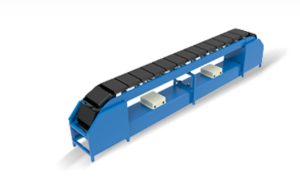
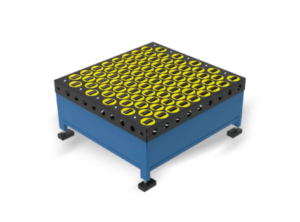
Linear sorters move product along a straight path and divert items sideways into chutes or spurs. The sliding shoe sorter uses small shoes that glide across the conveyor bed to gently guide items off the line, making it well suited to rigid cartons at medium to high speed. Pop up steerable roller sorters raise angled rollers to redirect flat bottomed cartons, while narrow belt and pusher style diverters offer cost effective routing for standardised packaging. Linear systems are generally more compact and more affordable for straightforward carton handling, which is why they remain a workhorse of conventional distribution.
Loop Sorters
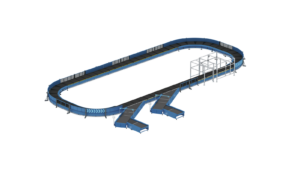
Loop sorters run in a continuous circuit, carrying items on a series of moving carriers. The cross belt sorter mounts a small powered belt on each carrier, which spins to eject items cleanly into a chute as it passes. The tilt tray sorter instead tips a tray to slide the item off. Both handle delicate and irregular goods with notable gentleness, achieve very high throughput, and allow multiple induction and divert points around the loop. The trade off is a larger facility footprint and a higher capital cost.
Overhead and Pouch Sorters
Often overlooked in general guides, the pouch or pocket sorter carries individual items in pouches suspended from an overhead rail. Because it uses vertical space rather than floor space, it is remarkably efficient in constrained buildings, and it has become a favourite in apparel distribution and returns processing where a single item often needs to be buffered, sequenced and re sorted. For any operation handling high volumes of garments or reverse logistics, it deserves a place on the shortlist.Throughput at a Glance
The table below offers a fast technical reference. Figures represent typical operating ranges; real world performance depends on item profile, induction design and software tuning.| System Type | Throughput (Items/Hour) | Facility Footprint | Ideal For |
| Sliding Shoe Sorter | 5,000 to 12,000 | Moderate, linear | Rigid cartons, mixed cases |
| Pop Up Roller Sorter | 3,000 to 6,000 | Compact, linear | Flat bottomed cartons |
| Cross Belt Sorter | 10,000 to 25,000+ | Large, loop | Polybags, mixed e commerce |
| Tilt Tray Sorter | 8,000 to 20,000 | Large, loop | Fragile and irregular goods |
| Pouch / Pocket Sorter | Varies, item based | Vertical, space saving | Apparel and returns |
Matching the Technology to the Task
This is where most procurement decisions are won or lost. A sorter is not a generic upgrade; it is a precision instrument calibrated to a particular product profile. Three variables matter above all others: throughput, packaging and item fragility.High Speed versus Medium Speed Throughput
Be honest about both your average and your peak. A facility comfortably handling 4,000 items an hour for most of the year may surge to three times that during seasonal peaks. Sizing only for the average leaves you exposed exactly when revenue is highest, while sizing purely for peak risks paying for capacity that sits idle. The discipline is to model your true throughput curve, including realistic growth, before any vendor quotes a machine.Dealing with Difficult Packaging
Packaging variability is the single most common cause of sortation disappointment. Non rigid items, the polybags, jiffy bags and tubes that now dominate e commerce, behave very differently from cartons. A polybag can slip, fold or snag on a pop up roller divert, and a soft mailer may not present a clean face to a shoe sorter. Cross belt and tilt tray loop systems, which lift and eject items individually, handle this mixed profile far more reliably. If polybags make up a meaningful share of your volume, this consideration alone may decide the technology.Handling Fragile and Oddly Shaped Items
Glassware, electronics and awkwardly proportioned goods demand a gentle divert. Tilt tray and cross belt sorters excel here because the item is carried rather than shoved, and it leaves the carrier with minimal lateral force. High impact pusher diverts, by contrast, are a poor match for anything that bruises or breaks. Matching divert mechanics to product fragility is not a detail; it is the difference between an acceptable damage rate and a stream of customer complaints.Packaging Suitability Matrix
| Packaging Type | Shoe Sorter | Cross Belt Sorter | Pop Up Roller |
| Rigid Cartons | Excellent | Excellent | Excellent |
| Polybags / Mailers | Limited | Excellent | Poor |
| Fragile Items | Moderate | Excellent | Limited |
| Envelopes / Flats | Limited | Good | Poor |
Cross Belt versus Sliding Shoe Sorter: Which is Best?
These two technologies sit at the centre of most high volume buying decisions, so they deserve a direct comparison. The sliding shoe sorter is a linear system prized for its accuracy with rigid cartons, its comparatively modest footprint and its lower capital cost. It is an excellent choice for operations whose volume is dominated by boxes and cases at medium to high speed. The cross belt sorter is a loop system built for scale and versatility. It comfortably exceeds the throughput ceiling of most linear sorters, processing upwards of 10,000 and often more than 20,000 items an hour, and it handles the full spectrum of e commerce packaging including the polybags that defeat many alternatives. The cost is space and capital: a loop consumes more floor area and carries a higher price tag. For a high volume e commerce operation with a varied product mix, that investment is frequently justified. For a carton dominated profile in a tight building, the shoe sorter often wins.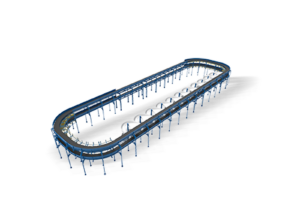
Calculating ROI and Business Value
A sortation system is a capital investment, and it should be defended with numbers rather than enthusiasm. In our experience most automated sortation projects reach return on investment within two to five years, with the exact timeline driven by labour savings, accuracy gains and the volume the system unlocks.Labour Cost Reductions
Manual sortation is labour intensive, error prone and increasingly difficult to staff. Automation redeploys people from repetitive sorting to higher value tasks and removes the scramble for temporary labour during peaks. In regions where warehouse staffing is both expensive and scarce, this single line item often dominates the business case.Order Accuracy and Returns Mitigation
Every misroute carries a hidden cost: the wrong item shipped, the refund processed, the customer lost. Automated sortation with high divert accuracy compresses error rates dramatically, and the resulting fall in returns and re shipments flows straight to the bottom line. Accuracy is not a soft benefit; it is a measurable saving.Understanding the Cost Per Divert
Rather than fixating on headline price, sophisticated buyers assess the cost per divert, the total system cost spread across the number of routing points and the volume processed over the equipment lifetime. Set alongside software licensing, integration and ongoing maintenance, this metric gives a far truer picture of value than a single capital figure ever could.Integration and Implementation Considerations
Facility Footprint and Layout Design
A sorter must be designed into the building, not merely dropped into it. Loop systems in particular demand careful planning around the circuit geometry, induction points, chute placement and the flow of goods both into and away from the line. Early layout modelling prevents the costly discovery that an otherwise ideal machine simply does not fit the operation it was bought to serve.Safety Standards and Machine Guarding
Modern sortation systems are safe when correctly specified and maintained. Machine guarding shields moving parts, emergency stop controls give operators immediate intervention, and sensor arrays detect obstructions before they cause harm. Compliance with the relevant safety standards, whether UKCA or CE marking depending on your market, is not optional, and any reputable integrator will treat it as foundational rather than an afterthought. “The machine almost never fails on paper. It fails on the loading dock, when a polybag that nobody profiled meets a divert that was never designed for it. Match the system to the packaging first, and the throughput numbers look after themselves.” — Daniel Hartwell, Senior Systems Engineer, SmartlogitecX