By Daniel Hartwell, Senior Systems Engineer, SmartlogitecX
A telescopic conveyor that pushes a moving belt to the nose of the truck, so your team stops carrying cartons and starts placing them. Here is how the machine is built, and how to choose the right one.
Every high volume shipping operation runs into the same bottleneck, and it is almost never the part of the building anyone planned around. Cartons move across the warehouse on a fixed conveyor line without much drama. Then the line reaches the dock door and stops. The last 50 feet, the stretch that runs into the throat of a parked trailer, becomes the slowest and most punishing part of the whole flow. That is the gap where your people walk, lift and stack by hand, often in summer heat, often near the trailer ceiling.
If you load and unload over the road trailers, you already know what that gap costs. It shows up as slower turn times, as injuries to shoulders and backs, and as the door you cannot keep staffed. You can automate everything upstream and still lose the gains at the dock face, because the equipment that carries product the final distance was never built to follow the operator into the trailer.
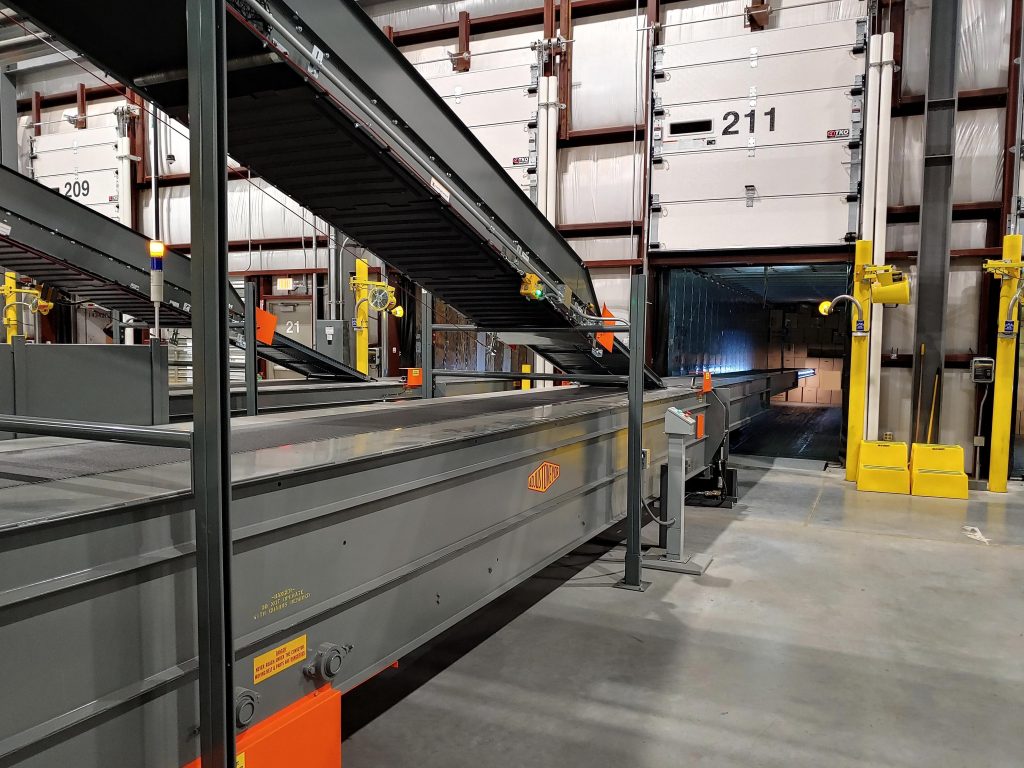
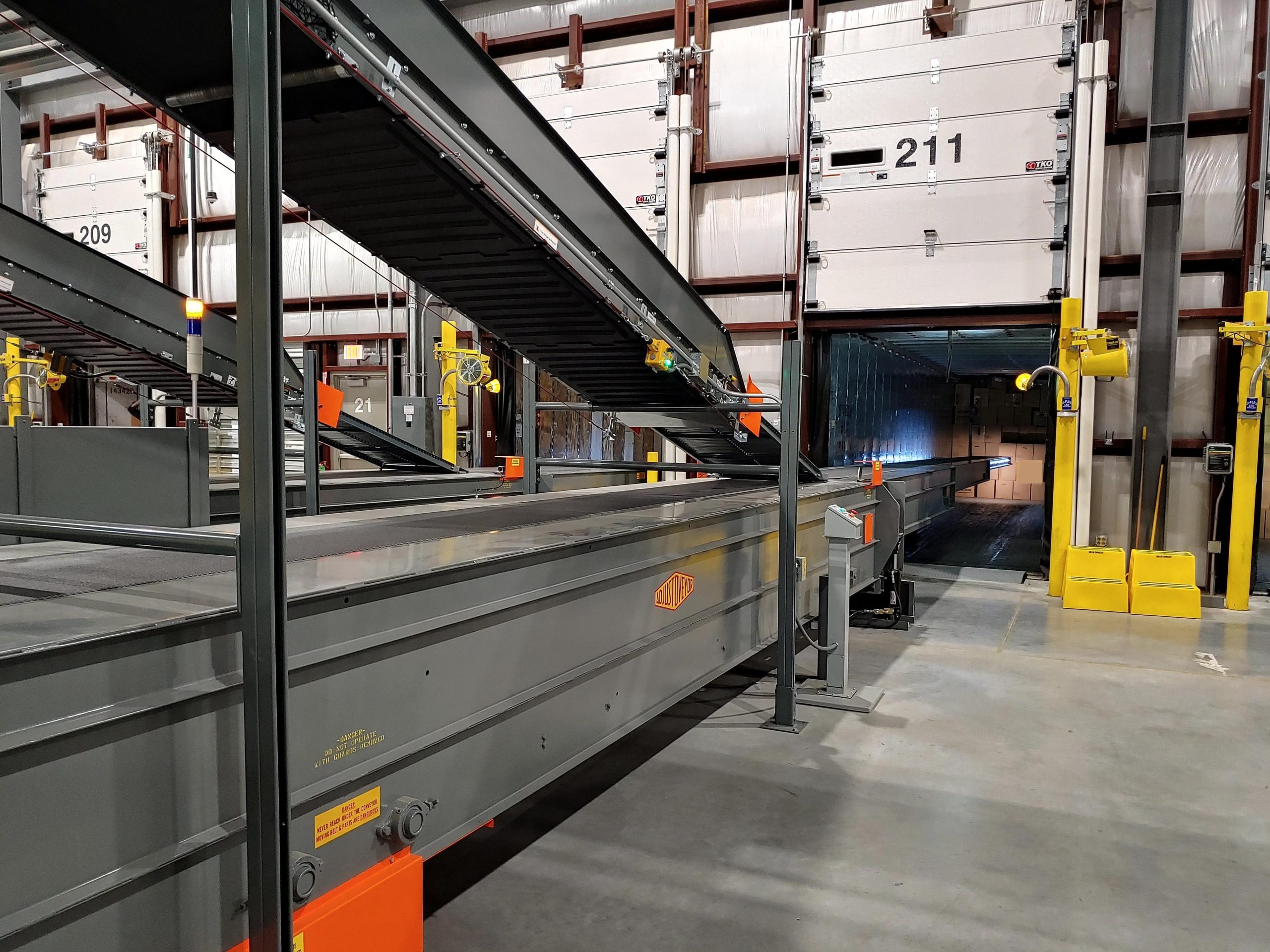
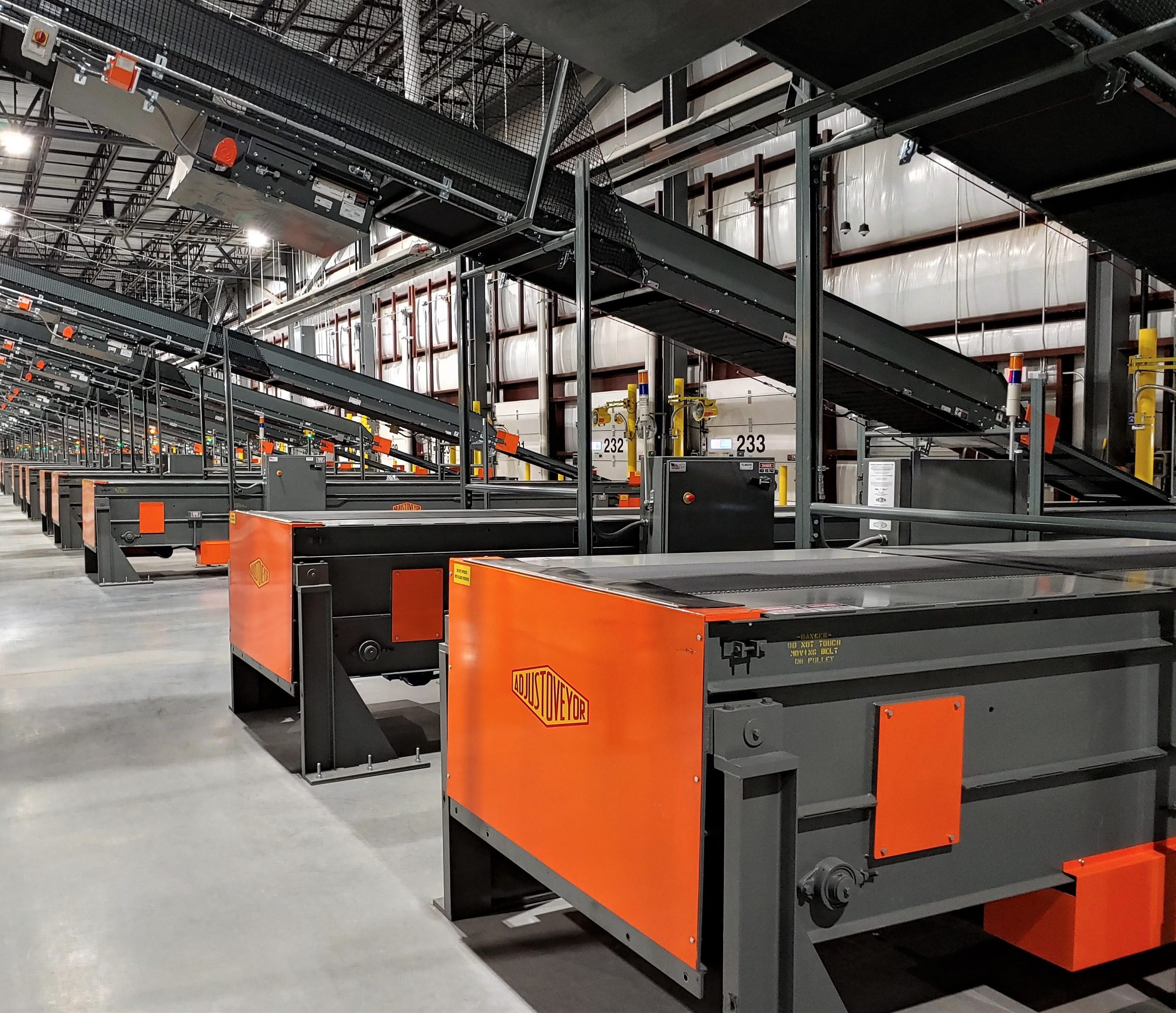
That is the problem the Adjustoveyor was designed to solve. It is a telescopic extendable conveyor that reaches out from the dock and delivers a moving belt straight into the truck, so cartons travel almost to the operator’s hands instead of being carried there. Stewart Glapat invented the machine in 1946 and has built it in Zanesville, Ohio ever since. The rest of this piece walks through how it works and, more usefully, how to spec the version that fits your dock.
The machine follows your operator into the trailer, so nobody walks the load
Start with what the Adjustoveyor actually changes on the floor. A conventional fixed conveyor ends at the dock leveller. From there, product has to be moved into the trailer somehow, which usually means people. A telescopic conveyor removes that handoff by extending its own belt into the trailer and retracting it as the load builds, keeping the discharge point close to the work the entire time.
The practical effect is that the conveying surface arrives where the cartons need to go. On the loading side, boxes ride the belt to the rear of an empty trailer, and the machine retracts row by row as the trailer fills. On the unloading side, the belt reaches in to meet product at the nose and carries it back to the fixed line. In both directions the operator places rather than carries, which is faster and far easier on the body.
Stewart Glapat builds an indexing feature into its loading machines, branded the Load X Adjustoveyor, that presents product to associates in a smooth and controlled flow rather than letting it surge. The company points to three operational gains from that approach, and they are worth stating plainly:
- A safer, more ergonomic dock: the belt does the travelling and the lifting that a worker would otherwise do by hand, which is the single biggest driver of injury reduction at the trailer face.
- One person across several doors: controlled, indexed presentation means a single associate can keep up with the flow, so labour is not pinned one to a door.
- A decades long service life: the structural build is designed for a low overall cost of ownership measured in decades rather than years, which is where the return on the equipment is made.
A single continuous belt and a nest of steel booms do the hard part
The engineering that makes all of this possible comes down to three systems working together: the booms that extend, the belt that covers the changing distance, and the steel structure that holds a loaded arm steady in mid air.
Nesting booms driven by a gear motor
The reach comes from a nesting boom structure, a set of steel sections built to slide one inside the next like a telescope laid on its side. A gear motor turns a jackshaft, and that jackshaft drives the booms outward when the operator wants reach and pulls them back when the trailer is full and the machine needs to clear the door. The motion is deliberate rather than quick, because every extended section carries weight that hangs out over open floor.
One belt that unspools instead of stretching
The belt is where the design earns its reputation. Instead of a series of short belts handing cartons from one to the next, the Adjustoveyor runs a single continuous loop of fixed length. As the booms extend, that belt routes through a set of internal rollers and unspools across the new distance, then takes the slack back up as the machine retracts. The surface stays flat and stays tensioned, and the belt never has to stretch to cover the gap. That is what lets a machine reach the nose of a trailer and still hand the operator a smooth, level surface to work from.
Structural steel and an eight point suspension
Holding it together is heavy structural steel channel rather than light gauge tube, and the load rides on an eight point suspension system built to manage the cantilevered weight of the booms when they are fully extended. That last point matters more than it sounds. A telescopic conveyor spends much of its working life with a long, loaded arm projecting into thin air, and the suspension is what keeps that arm rigid instead of letting it sag. It is also a large part of why these machines last as long as they do.
Match the boom count to your floor, not just your trailer
The number of booms on a machine is the first specification most buyers settle, because it governs two things at once: how far the conveyor reaches, and how much room it occupies when parked. The useful insight is that those two are linked. Every additional nested section buys more extension and, less obviously, a shorter retracted footprint for the same reach.
Single and double booms for modest reach
Single and double boom units suit standard loading docks where the reach requirement is modest and floor space is not under pressure. A double boom, with two nested sections, handles docks that do not demand a full run into a long trailer. These are the simplest machines to specify and to live with, and they are the natural entry point to the range.
Triple booms as the distribution baseline
Three boom setups are the workhorses of standard distribution. A triple boom is generally the baseline for loading and unloading a standard 53 foot trailer, because three sections give enough extension to reach deep into the trailer while keeping the retracted machine to a sensible length at the door. For most distribution centres moving cartons in and out of over the road trailers, this is the default choice.
Four and five booms when floor space is tight
Four and five boom machines exist for facilities fighting for floor space, and the logic is counterintuitive at first. A five boom unit has five nested sections rather than two, and more sections let the conveyor throw a long arm into the trailer yet collapse into a much shorter, more compact footprint on the warehouse floor. Where a dock limits how far a parked conveyor can intrude into the building, the extra booms buy that room back without giving up reach. The trade is more moving sections to synchronise and maintain, which is why operations choose them deliberately rather than by default.
The options decide whether a standard machine becomes the right machine
Two docks are rarely identical, and the option list is where a catalogue machine becomes a fit for your building. Most of the choices revolve around one question: getting the belt to the right height for the work and the worker, and then keeping that work safe.
Height set by hydraulics
Height is managed with hydraulics. A base lift tilts the whole unit to set the working angle, while a front end stacker works at the nose of the machine, raising or lowering the discharge end on its own. The front end stacker also swings up toward 90 degrees in the retracted position, which keeps the nose clear and prevents clearance problems at the door. Both run on push button controls, so an operator sets the height without stepping away from the work.
Man on Board platforms for the high tiers
Stacking the top rows of a trailer near the ceiling is where shoulders and backs get hurt. The Man on Board option answers that with a powered operator platform that attaches to the unit and rises alongside the belt, lifting the worker to a comfortable height for the high tiers without step stools or overhead lifting. Stewart Glapat builds it with an automatic levelling device that keeps the platform flat without the operator having to manage it.
Gator style declines for manual palletising
At the discharge end, a Gator style decline adds vertical adjustability for building pallets by hand. As a pallet grows taller, the operator uses push button controls to drop or raise the discharge height to match the layer being worked, so cartons arrive at a comfortable level rather than being lifted or set down. It is a small piece of ergonomics that compounds across a full shift.
Fixed or mobile across multiple bays
Finally there is the question of whether the conveyor stays put. Many units are bolted to the floor at a single dock door. Others ride on powered undercarriages that roll laterally along floor tracks, letting one machine and one operator serve several adjacent loading bays. For operations that cannot justify a dedicated conveyor at every door, that lateral movement is often the feature that makes the numbers work.
Controls and safety built to integrate
A telescopic conveyor rarely works alone, so the control package is built to talk to the rest of the building. Speed is governed by variable frequency drives and microprocessors that let the belt match the pace and indexing of the fixed lines and sorters feeding it, and the machines can be wired with programmable logic controllers to sit inside a wider automated flow. Safety hardware is treated as standard rather than an upgrade: emergency stop buttons run the length of the booms, the control system is built around Category 3 safety circuits, and physical guarding covers the pinch points between the telescoping steel sections.
Specify the machine to your dock, then put it to work
Strip away the options and the proposition is simple. The Adjustoveyor is a heavy duty structural steel conveyor that bridges the dock and the trailer and is built to run for decades. The decisions that matter come down to fit: how far the machine has to reach, how much floor it can occupy retracted, how high the belt needs to travel, and whether it serves one door or several.
Before you specify a unit, measure your dock dimensions and confirm the weight capacities your cartons demand, then match those numbers to a boom count and option set. When you are ready, request a quote from SmartlogitecX, or review the Adjustoveyor product range to see the configurations side by side.
Core Functionality
The primary purpose of an Adjustoveyor is to provide a variable-length conveying surface that can extend directly into a truck or trailer for loading/unloading and retract completely when not in use to free up dock space.- Telescoping Mechanism: It consists of multiple nested “booms” (ranging from one to five) that extend and retract. When extending, it reaches into the truck; when retracting, it collapses into a compact footprint on the dock.
- Belt System: Despite the telescoping booms, the conveyor belt remains a single, continuous, fixed-length unit. The belt is routed in a complex forward and rearward path through the nested booms and fixed section, allowing it to maintain a continuous conveying surface regardless of the extension length.
- Synchronized Motion: Extension and retraction are driven by a gear motor connected to a jackshaft. A system of chains, sprockets, and linkages ensures that all smaller booms move in a synchronized, proportional motion.
- Structural Integrity: Built using structural steel channels and an 8-point suspension system, the conveyor is engineered to support heavy loads (typically up to 65–100 lbs per lineal foot) while maintaining a steady, rigid platform even when fully cantilevered into a trailer.
Key Operational Features
- Ergonomics: Many units include hydraulic lifts to adjust the conveyor height to match the floor of the trailer, which significantly reduces the physical strain on operators who would otherwise have to lift items overhead or from the floor.
- Integration: It can be integrated into existing systems via gravity conveyors, chutes, or powered inclines. Some models include “Man-on-Board” platforms that lift the operator to help reach items near the trailer roof.
- Mobility: While some units are fixed to a specific dock door, others feature powered undercarriages that allow them to traverse along the dock to service multiple doors.
- Versatility: Additional options include front-end stackers (to minimize the distance between the belt and the product), specialized incline/decline sections, and advanced controls like variable frequency drives.
Adjustoveyor Model Classifications
These models range from single-boom units for simple dock applications to multi-boom configurations designed for deep-reach loading/unloading into long trailers.
Category | Typical Model Examples | Key Characteristics |
Single Boom | 1527S, 2036S | Simplest design; ideal for standard length reach requirements. |
Double Boom | 1431D, 1843D, 2560D, 3282D, 3797D | Offers longer extensions for larger trailers while keeping a compact retracted size. |
Triple Boom | 1858T, 2169T, 2374T, 2580T, 2787T, 3095T | High-reach capability for deep loading; popular for high-volume distribution centers. |
Four Boom | 1557Q, 2074Q, 2488Q, 2588Q, 2294Q | Designed for extreme reach requirements where floor space is limited. |
Five Boom | 1352V, 1564V, 1978V | Specialized configurations for specific high-density logistical needs. |
Key Specialized Options
Beyond the standard boom configurations, these conveyors are often customized with specific features to meet operational demands:
- Front-End Stacker: Allows the operator to adjust the height of the conveyor nose, minimizing the physical lift required for product entry or exit.
- Man-on-Board: A platform that elevates the operator to a comfortable working height for loading/unloading items near the top of a trailer, significantly improving ergonomics.
- Gator-Style Decline Conveyor: A newer option designed to simplify palletizing and offer smooth, push-button-controlled up-and-down motion for better product transition.
- Automatic Leveling & Control: Advanced units include microprocessors, Variable Frequency Drives (VFDs), and safety circuits (e.g., Category 3 safety) to integrate seamlessly into automated warehouse systems.
These systems are built to be rugged, typically using structural steel channels and an 8-point suspension system to ensure long-term reliability in high-throughput environments.
Frequently asked questions
What is an Adjustoveyor?
It is an extendable conveyor that telescopes outward to reach inside trucks and trailers, giving operators a single continuous belt surface for loading and unloading cartons. Stewart Glapat invented the equipment in 1946 and still manufactures it in the United States.
How does the conveyor belt adjust when the booms extend?
The belt is a single continuous loop of a fixed length. As the machine extends, that belt unspools through a series of internal rollers, keeping a flat conveying surface across the new distance without physically stretching. When the booms retract, the belt takes up the slack again.
Who manufactures this equipment?
The system is built by Stewart Glapat, the company that originally invented it in 1946, at its plant in Zanesville, Ohio.
What is the weight capacity of a standard unit?
Capacity depends on the model and length. As a general guide, these units are typically rated to carry between 65 and 100 pounds per lineal foot, so confirm the exact rating against the model you are specifying.
How does a five boom model differ from a double boom model?
A five boom model has five nested sections where a double has two. More sections let the conveyor reach far into a trailer while retracting into a much shorter, more compact footprint on the warehouse floor, which is why operations short on space choose them.
How do operators load boxes near the ceiling of a trailer?
They use a Man on Board platform, a powered lift that attaches to the unit and raises the operator alongside the belt. It removes step stools and overhead lifting, and an automatic levelling device keeps the platform flat throughout.
Can one conveyor service multiple dock doors?
Yes. Many units are bolted to the floor at a single door, but a machine can be built on a powered undercarriage that rolls laterally along floor tracks to serve adjacent loading bays, which lets a single operator work several doors.
How is the height of the conveyor belt controlled?
Height is set with hydraulic lifts. A base lift tilts the whole unit, while a front end stacker raises or lowers the nose of the belt independently. Both use push button controls, and the front end stacker also swings up near vertical when retracted to avoid clearance issues.
Are these units compatible with automated sorting systems?
Yes. They can be fitted with programmable logic controllers and variable frequency drives so the belt matches the speed and indexing of facility wide sorting lines, allowing the machine to sit cleanly within a larger automated flow.
What is a Gator style decline conveyor?
It is an add on that gives vertical adjustability at the discharge end. Operators use push button controls to raise or lower the height to match the pallet they are building, so cartons arrive at a comfortable working level during manual palletising.
What safety features are standard on these machines?
Standard hardware includes emergency stop buttons along the length of the booms, Category 3 safety control circuits, and physical guards over the pinch points between the telescoping steel sections.
What maintenance do these conveyors require?
Routine maintenance involves checking the tension of the primary belt, lubricating the drive chains and sprockets, and inspecting the linkages that synchronise boom movement. Kept up, the structural steel build is designed for a long and low cost service life.
How long does an Adjustoveyor last?
Because the machines are built from heavy structural steel and carried on an eight point suspension system, they are designed for a decades long productive life with a low overall cost of ownership, provided routine belt, chain and linkage maintenance is carried out.