Both machines promise to reclaim your floor. The right one depends on what you store and how tall your building is.
Walk through almost any Australian distribution centre or fabrication shop and you will find the same quiet problem. Shelf after shelf of parts that barely move: fasteners, spare components, service kits, seasonal lines. Each item earns its keep a few times a year, yet together they swallow floor space that costs more every quarter.
Vertical automation is the usual answer, and the case is hard to argue with. A modern vertical warehouse storage machine can hand back up to 90 percent of the floor that a run of static shelving would occupy, according to Italian manufacturer ICAM, whose systems SmartlogitecX supplies across Australia. That is not a rounding error. For a growing business it can be the difference between signing a lease on a second warehouse and staying where you are.
The trouble starts when buyers begin shopping. Many go looking for a vertical carousel when the machine that actually suits their stock is a vertical lift module. From across a warehouse floor the two look alike. Under the skin they work differently, and picking the wrong one is an expensive mistake to unwind. Get it right and you reclaim space, speed and accuracy at once. Get it wrong and you own a tall machine that will not hold your heaviest parts.
Here is what you need to know about vertical carousels, how they differ from lift modules, and which one earns its place when your inventory is high mix and low volume.
» MORE: How automated vertical storage compares with static racking
What is a vertical carousel storage system?
A vertical carousel is an enclosed storage machine built around a loop of carriers that rotate like a Ferris wheel. Scan an order or press a button, and the carousel spins the right carrier down to an opening at waist height, where an operator picks the item without walking or bending. Engineers call this goods to person picking, because the machine brings the stock to the worker rather than sending the worker into the aisles.
Carousels are compact, quick for light items, and simple to run. Because every carrier hangs from the same chain, they suit inventory that is fairly uniform in size and weight: small components, documents, light tooling, service kits. Load a carousel with heavy or dense parts, though, and the design starts to strain. The whole loop has to carry that weight, which limits how much each carrier can safely hold.
That single constraint is why so many warehouses that begin by asking for a carousel end up specifying something else.
What is a vertical lift module, and why the two get confused?
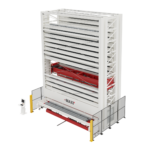
A vertical lift module, or VLM, tackles the same floor space problem with a different mechanism. Instead of a rotating loop, a VLM stores trays in two fixed columns, one at the front and one at the back, with a lift running up the middle. When you call for an item, the lift travels to the correct tray, pulls it, and delivers it to a picking window. Nothing else in the machine moves.
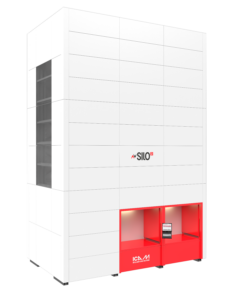
ICAM’s SILO² is a current example. It is a multicolumn lift module, not a carousel, even though buyers often use the two words as if they mean the same thing.
The confusion is understandable. Both machines are tall, enclosed, and deliver goods to person. Both save floor space. Both can be driven from a screen and tied into warehouse automation software. But the lift module’s fixed columns and independent lift give it a real advantage with heavy and mixed loads, because the weight sits on the structure rather than on a moving chain.
For anyone storing a wide range of parts at different weights, which describes most high mix inventories, that difference matters far more than the shared marketing language suggests.
Why high mix, low volume inventory is the hardest to store
High mix, low volume is exactly what it sounds like. You hold a large number of different items, and you pick each one only occasionally. A maintenance store might list ten thousand parts and touch most of them a handful of times a year. An electronics assembler might carry thousands of components, most of them slow movers kept on hand so a production line never stops.
On static shelving this profile is punishing. Slow moving stock spreads across long aisles, pickers walk kilometres to assemble a single order, and mistakes creep in as similar looking parts sit side by side. Floor space is consumed by inventory that rarely earns attention, and every new line makes the walk longer.
Consider a regional plant that keeps spares for a fleet of machines. It might stock everything from tiny sensors to heavy gearbox parts, each one ordered only when something fails. On shelving those spares occupy a whole corner of the building, and finding the right one can take a walk and a ladder. In a lift module they occupy a single window.
Vertical automation flips that arithmetic. By stacking stock upward and delivering it to a single window, a carousel or a lift module collapses a long aisle into a compact footprint and cuts the walking to near zero. Pickers stay in one place. The machine tracks what is where, and it lifts only what you ask for. This is the sweet spot for the technology, and it is why high mix, low volume warehouses are the ones most often shopping for it.
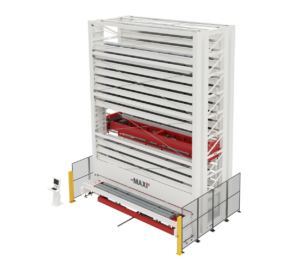
Carousel or lift module: which suits high mix, low volume?
Both machines will shrink your footprint. The right choice comes down to what you store and how tall your building is.
A vertical carousel tends to win when:
- Your stock is light and fairly uniform in size.
- You want a simple machine with a small footprint.
- Ceiling height is modest and your range is stable.
A vertical lift module tends to win when:
- Your parts vary widely in size and weight.
- You store dense or heavy items alongside light ones.
- You have height to build into, and your range keeps growing.
Because high mix inventories almost always include a spread of weights, the lift module is usually the safer long term choice for this profile. It handles the light electronics and the heavy fittings in the same machine, and it scales upward as you add lines. A carousel can still be the right call for a narrow, light range, but it becomes hard to justify the moment the load gets heavy or the mix gets wide.
This is where matching the machine to the material pays off. Buyers who choose on price alone, or on the first word they typed into a search bar, sometimes discover the limit only after installation, when a carrier will not take the part they need it to hold.
» MORE: Matching automated storage to your inventory profile
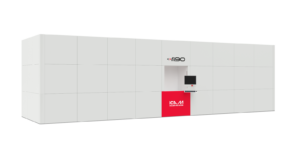
A closer look at a modern lift module
To see why a lift module suits mixed stock, it helps to read the specifications of a current system. ICAM lists the following for its SILO² module, and the figures show how much range a single machine can cover.
The SILO² is built with two to seven columns and can reach up to 15 metres tall, so it grows with the building rather than the footprint. Trays carry up to 400 kilograms each, and the machine offers around 120 tray sizes, with usable widths from 653 to 2,053 millimetres. Most important for mixed inventories, its specific load capacity runs from 113 up to 1,001 kilograms per square metre. That range means dense steel components can sit in the same machine as light plastic parts, which is precisely the problem a carousel struggles with.
Throughput is configurable too. ICAM offers two versions: a FAST build that lifts hourly output by more than 30 percent, and an ECO build that cuts energy use by around 20 percent. Between them the machine handles roughly 53 to 87 trays an hour, and it can be fitted with one to eight picking stations, so an operator picks at one window while the next tray is readied at another. On a busy day, that overlap is where the time savings come from.
A lift module also earns its keep through how each tray is divided. ICAM offers a wide range of internal accessories for the SILO², including removable dividers, side extensions and containers, so a single tray can be split into dozens of small compartments. Software then decides where each item lives, grouping stock by product family, picking frequency and size. For a high mix store, that is how thousands of separate lines fold into one machine without losing track of any of them.
Software ties it together. The system runs on ICAM’s ICON platform, which integrates with common warehouse and enterprise software and tracks stock by item, batch and order. Safety is built in, with light curtains, an automatic shutter door and emergency stops at the picking station. And because the structure is self supporting, it can be installed in low ceilings, underground, or even outdoors.
None of this makes a lift module the answer for every warehouse. It makes it the answer for a mixed, dense, growing range, which is the high mix, low volume case.
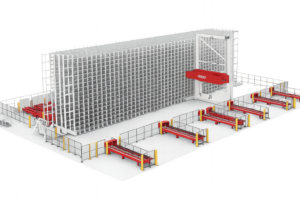
When a carousel or lift module is not the answer
Vertical small parts machines are not universal. Get the material wrong and even the best system will underperform. Three cases call for a different design.
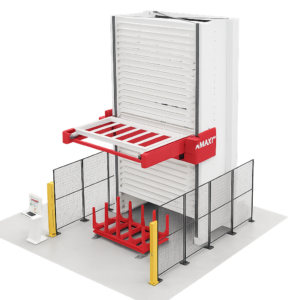
- Long materials. If you store bars, profiles, pipes or extrusions, a small parts machine will not help. ICAM’s MAXI L is built for exactly this, holding long and heavy stock up to 7,100 millimetres in drawers rated to as much as 3,000 kilograms. It suits window and door makers, metal fabricators and anyone handling long stock.
- Panels and sheet metal. Flat, bulky material needs its own approach. The MAXI T is a tower system for sheet metal and panels, with drawers rated to 3,000 kilograms and heights up to 12 metres, aimed at fabricators and sheet processors.
- High volume long goods. When you manage hundreds of load units of long material and manual handling has become the bottleneck, a stacker crane makes sense. ICAM’s MAXI STC is an automated storage and retrieval system that handles 400 or more load units up to 7 metres long on a fully automated cycle.
The lesson is the same across all three: choose the machine around the material, not the other way around.
What Australian buyers should weigh
Beyond the machine itself, a few local factors shape the decision.
Floor cost is the headline. With warehouse rents under pressure in Sydney, Melbourne and Brisbane, the value of reclaiming up to 90 percent of a footprint is easy to translate into dollars per square metre saved. Put simply, if a machine lets you avoid renting an extra few hundred square metres, that saving compounds every month for the life of the lease. That calculation is often what turns interest into a purchase.
Labour is the second factor. Skilled warehouse staff are hard to find and keep, and goods to person picking lets a smaller team pick more accurately, which eases both cost and risk.
Lead time and support matter just as much. These are imported systems, so ask about realistic delivery and installation windows before you plan around a date. Just as important, confirm who installs, services and stocks spare parts for the machine in Australia. A vertical module is a long term asset, and local support is what keeps it running.
Finally, check that the installation meets Australian workplace safety expectations, including guarding and emergency stops, which reputable systems build in as standard.
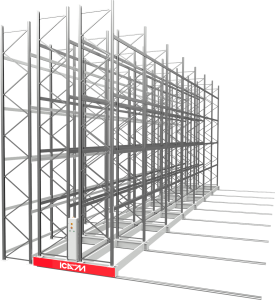
How to choose: six questions to ask before you buy
Before you talk to a supplier, work through these.
- Count your SKUs and how often each moves. A wide, slow moving range points toward vertical automation.
- Weigh your heaviest and densest items. If they are heavy, lean toward a lift module rather than a carousel.
- Measure your ceiling height. More height means more storage in the same footprint.
- Map your pick rate. Busy operations may want several picking stations or the faster machine build.
- Check integration. Confirm the system connects to your warehouse or enterprise software and tracks stock by batch and order.
- Ask about local service and spares. Delivery, installation, maintenance and parts should all be answered before you sign.
Answer these honestly and the right machine usually names itself.
The bottom line
A vertical carousel is a capable machine, and for a light, uniform range it can be the neatest solution on the floor. But high mix, low volume inventory rarely stays light or uniform. As the range widens and the weights spread, a vertical lift module such as the SILO² tends to be the more durable choice, because it carries dense stock and light stock in the same footprint and grows as you add lines.
Whichever way you lean, the principle holds. Match the machine to the material, weigh the Australian factors of floor cost, labour and local support, and let your own inventory make the decision.
Frequently asked questions
What is the difference between a vertical carousel and a vertical lift module?
A vertical carousel rotates a loop of carriers to bring stock to the operator, like a Ferris wheel of shelves. A vertical lift module stores trays in fixed columns and uses a central lift to fetch only the tray you need. Both deliver goods to person picking, but the lift module handles heavy and mixed loads more comfortably, because the weight rests on the structure rather than on a moving chain.
Which is better for high mix, low volume inventory?
For most high mix, low volume warehouses a vertical lift module is the safer choice, because these inventories usually mix light and heavy parts. A lift module such as the SILO² can store both in the same machine. A carousel can still suit a narrow, light and stable range, but it becomes hard to justify once the load gets heavy or the mix widens.
How much floor space can a vertical storage system save?
Manufacturer figures are striking. ICAM states its systems can recover up to 90 percent of the floor that static shelving would use, by stacking stock upward and delivering it to a single window. The exact saving depends on your ceiling height and current layout, but the direction is always the same: a much smaller footprint for the same stock.
Can a vertical lift module store heavy or dense parts?
Yes, and this is where a lift module separates from a traditional carousel. ICAM rates SILO² trays to 400 kilograms each, with a specific load capacity from 113 up to 1,001 kilograms per square metre. That range lets dense steel components sit alongside light electronics in one machine, which is difficult for carousel designs to match.
Is a carousel or a lift module faster for picking?
Speed depends on configuration rather than machine type alone. A lift module with several picking stations lets an operator pick at one window while the next tray is prepared at another, which trims waiting time. ICAM lists roughly 53 to 87 trays an hour for the SILO², with a faster build available where throughput is the priority.
What is goods to person picking?
Goods to person picking means the storage machine brings the item to a stationary operator, instead of sending the operator into the aisles to find it. Carousels and lift modules both work this way. It cuts walking to near zero, speeds up picking and reduces errors, which is why it suits warehouses with many slow moving lines.
How many SKUs can a vertical storage system hold?
There is no single number, because capacity depends on tray sizes, machine height and how you divide each tray. A tall lift module with many tray sizes and internal dividers can consolidate thousands of separate lines into one footprint. The practical limit is usually set by your building height and item sizes rather than by the machine itself.
Do vertical storage systems connect to warehouse or enterprise software?
Modern systems do. The SILO² runs on ICAM’s ICON platform, which integrates with common warehouse management and enterprise software and tracks stock by item, batch and order. That link keeps inventory records accurate and lets the machine take instructions straight from your existing systems.
What should Australian buyers check before purchasing?
Look beyond the machine. Confirm realistic delivery and installation timelines for an imported system, and check who provides local installation, servicing and spare parts. Weigh the floor space saving against your warehouse rent per square metre, and make sure the installation meets Australian workplace safety expectations, including guarding and emergency stops.
When should you choose a stacker crane AS/RS instead?
A stacker crane suits high volume long goods rather than small parts. If you manage hundreds of load units of long material such as bars and profiles, and manual handling has become a bottleneck, a system like ICAM’s MAXI STC handles 400 or more load units up to 7 metres long on a fully automated cycle. Below that scale, a lift module usually fits better.