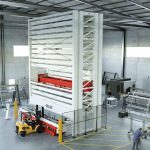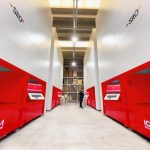
Vertical lift modules are among the best known automated storage systems on the market. Before you commit the capital, here are the factors that decide whether the system still fits your operation in five years, not just this quarter.
By the SmartLogitecX editorial team. Reviewed by our warehouse automation specialists. Figures cited are drawn from manufacturer specifications and independent Australian market research current to 2026.
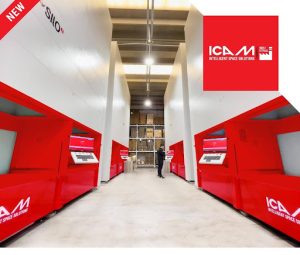
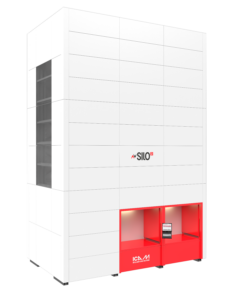
A vertical lift module brings stored items to the operator at an ergonomic picking station, the goods to person principle at the heart of the category. Pictured: the ICAM SILO2 multi column VLM. Source: ICAM.
If you run a warehouse or a production store in Australia, the maths behind your automation decision has rarely looked this stark. Industrial vacancy rates are sitting near record lows of about 2.8 percent, land values keep climbing in every capital city, and warehousing roles remain on national skills shortage lists. Industry research suggests more than 70 percent of Australian logistics leaders plan to invest heavily in automation over the next five years. In that environment, a vertical lift module is no longer a nice to have. It is one of the clearest ways to store more in the same footprint and pick faster with fewer people.
The vertical lift modules are proven, widely deployed and genuinely capable. The risk is not that is a poor choice. The risk is that buyers judge any vertical storage system on the wrong criteria, weighting the numbers printed on the front of a brochure and overlooking the factors that actually decide value over a ten to fifteen year asset life.
This guide walks through those overlooked factors, using ICAM, the Italian manufacturer represented in Australia by SmartLogitecX, as a comparison where it helps. The aim is not to tell you which brand to buy. It is to help you ask sharper questions before you sign.
What are vertical storage systems?
Vertical storage systems are automated vertical storage and retrieval machines, built mainly around the vertical lift module, or VLM. A VLM stores goods on trays inside a tall enclosed structure and uses an automated lift to deliver the requested tray to an operator at an ergonomic height. This is the goods to person principle: the machine brings the item to the person, rather than the person walking the aisles to find it.
Vertical Lift, offers a throughput of up to 130 trays per hour and a tray payload of up to around 990 kilograms (2,200 pounds), according to the company’s published specifications. The compact Slim suits tight footprints, and the range extends to horizontal carousels, a pallet handling model and controlled atmosphere units for sensitive stock. Every machine is coordinated by warehouse management software(WMS) that integrates with common ERP and inventory platforms. ICAM reports its systems can recover up to 90 percent of the floor space taken by conventional shelving, a claim echoed right across the VLM category.
That last point matters. Most reputable VLMs, ICAM products included, deliver broadly similar headline benefits: dramatic floor space recovery, faster and more accurate picking, and better ergonomics. Which is exactly why the headline benefits are the wrong place to make your decision.
Why this evaluation matters more in Australia
The Australian market puts unusual pressure on the choice. Prime logistics rents have risen sharply since 2022, and industrial land near Sydney, Melbourne and Brisbane is both scarce and expensive. Automated storage and retrieval systems can lift storage density by 40 to 60 percent and improve picking productivity by 200 to 300 percent, according to industry analysis, so the space and labour case is genuinely compelling.
But the capital is real. Warehouse automation projects in Australia commonly run from several hundred thousand dollars to many millions, with payback typically landing in the one to three year range when the business case is sound. A machine that is well matched to your operation pays that back and keeps earning. A machine that is subtly mismatched, too small to scale, too limited in the materials it can hold, or poorly supported once it is on your floor, becomes an expensive constraint you live with for a decade. The stakes justify a harder look.
Seven factors buyers often overlook
Column architecture and how it scales
Almost every VLM works the same way at the core: two facing columns of trays with a lift running between them. The question buyers rarely ask is what happens when the number of stored references outgrows a single machine. With most systems, you add another machine, another lift and another footprint. Some systems take a different route. ICAM’s SILO², for example, is designed as a multi column module that can be configured with two to seven storage columns served by a single elevator, so one machine holds far more references and one operator can serve a wider catalogue from a fixed station. When you are planning for growth, ask each vendor to show you the path from your day one setup to double the references. The answer reveals how the architecture scales, and how much extra floor and capital that growth will cost.
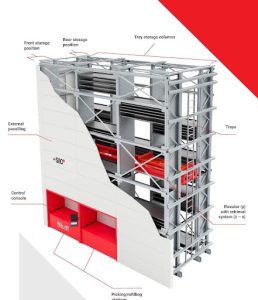
Inside a SILO2: shifting trays sit in the storage columns while a central elevator retrieves and returns them to the picking and refilling stations. Source: ICAM.
Specific load capacity, not just tray payload
Here is a distinction that trips up a lot of buyers. Tray payload is the total weight one tray can carry. Specific load capacity is the weight the system supports per square metre of tray. They are not the same, and they do not always favour the same machine. The flagship trays carry up to around 990 kilograms each, a high figure. ICAM’s SILO² caps tray payload at 400 kilograms but supports a specific load of up to 1,001 kilograms per square metre, which suits dense items packed across smaller trays. Neither number is universally better. The point is to test both against your actual heaviest and densest lines. A generous per tray figure on a large tray can still leave you unable to store your densest components efficiently, and a strong density figure does not help when you need to place one very heavy item on a single tray.
Real throughput, not the headline figure
Trays per hour looks like a clean comparison, but it describes a machine running under ideal conditions. Real throughput depends on how intelligently the software places your stock. Systems that use ABC classification, positioning your fastest moving items in the most accessible locations, deliver far more picks in practice than the raw figure suggests. ICAM quotes 53 to 75 trays per hour for its energy focused ECO version and 72 to 87 for its performance focused FAST version, with both lifted by the ICON software’s allocation logic. When you compare, ask for throughput modelled on your own order profile, not a factory maximum.
Energy and running costs
The purchase price gets scrutiny. The power bill rarely does, even though it runs for the life of the machine. Installed power varies meaningfully between models and configurations. ICAM, for instance, offers SILO² in an ECO configuration drawing 11 kilowatts that the company says cuts overall energy use by about 20 percent, and a FAST configuration at 14 kilowatts that trades that saving for roughly 30 percent more hourly performance. Over ten years of operation, that gap is real money. Ask every vendor for installed power and typical consumption under your duty cycle, then fold it into the total cost, not just the quote.
Material breadth and single vendor consolidation
This is the factor most tied to long term growth, and the one small parts focused VLM ranges tend to expose. A VLM is superb for components, spare parts and small to mid sized items. It is not built for long stock like bars, tubes and extrusions, for large panels and sheet metal, or for very high volumes of long load units. As operations grow, their storage mix often broadens. If your chosen supplier only makes small parts VLMs, you end up buying a second system from a second vendor, on a second software platform, with a second support relationship. ICAM approaches this differently: alongside SILO² for small and mid sized parts, its MAXI L handles long materials up to 7,100 millimetres, its MAXI T stores panels and sheet metal with drawer loads up to 3,000 kilograms, and its MAXI STC is a stacker crane system for operations running more than 400 long goods load units, all coordinated by the same ICON software. Whether or not you need that breadth today, it is worth knowing which suppliers can grow across material types without forcing you onto a patchwork of systems.
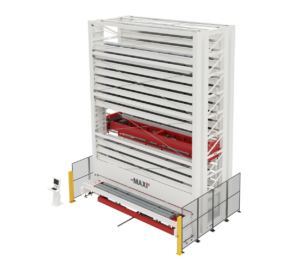
Breadth in practice: the ICAM MAXI L stores long profiles, tubes, accessories and molds, materials a small parts VLM is not built to hold. Source: ICAM.
Installation flexibility
Most buyers assume a VLM goes indoors, on a flat floor, in a standard bay. The better systems are far more flexible, and that flexibility can save an expensive building extension. ICAM’s SILO² can be installed outdoors in an insulated enclosure, in basements, across multiple building levels, in corner and U shaped layouts, and even inside a lift shaft, extending beyond 70 metres in height using a patented tray exchange between floors. If your site is constrained, and most Australian sites are, ask whether the system can use the awkward space that shelving simply cannot.
Local support, lead time and spare parts
This is the factor that quietly decides how the next decade feels. An imported machine is only as good as the local team that installs, services and stocks parts for it. Lead times from Europe need to be planned into your project and your cash flow. A dedicated local partner, such as SmartLogitecX for ICAM in Australia, means installation, servicing and spare parts are handled onshore rather than from the other side of the world. Before you sign, get specifics: who commissions the system, what the service response time is, where spare parts are held, and exactly what a maintenance contract covers.
How the options compare on the factors that matter
No single system wins on every factor, and any vendor that claims otherwise is selling rather than advising. On raw tray payload, ICAM flagship is strong. On configurable density and multi column scaling, ICAM’s SILO² has a clear design advantage. On breadth of materials, ICAM’s wider range covers ground a small parts VLM does not. On brand familiarity and a long deployment history, ICAM is well established. The honest conclusion is that the right answer depends on your materials, your growth plan and your appetite for a single vendor relationship. The table below is a starting point, based on published specifications. Confirm current figures with each vendor before you decide.
| Factor | Current (VLM range) | ICAM (SILO² and MAXI range) |
|---|---|---|
| Core VLM architecture | Two column vertical lift module | Multi column module, two to seven columns per elevator |
| Maximum tray payload | Up to around 990 kg (General Lift) | Up to 400 kg per tray (SILO²) |
| Specific load capacity | Not stated in reviewed materials; confirm with vendor | Up to 1,001 kg per square metre (SILO²) |
| VLM throughput | Up to 130 trays per hour (Normal Lift) | ECO 53 to 75, FAST 72 to 87 trays per hour |
| Material breadth | VLMs, carousels, pallet and controlled atmosphere units | Small parts VLM plus long goods, panels and stacker crane systems |
| Energy options | Confirm installed power with vendor | ECO 11 kW or FAST 14 kW versions |
| Installation flexibility | Indoor and outdoor VLM options; confirm with vendor | Indoor, outdoor, basement, multi level and lift shaft layouts |
| Software | WMS, integrates with ERP and inventory systems | ICON, native WMS and ERP integration, ABC allocation |
| Australian support | Via appointed distributors | SmartLogitecX, local install, service and spares |
Matching the system to your materials
A quick way to sanity check any shortlist is to match the machine to what you actually store.
- Small and mid sized parts at high turnover: a VLM is the natural fit. This is the core battleground for ICAM’s SILO².
- Long materials such as bars, tubes and profiles: you need a purpose built long goods system, such as ICAM’s MAXI L, rather than a small parts VLM.
- Panels and sheet metal: look at a system designed for flat and delicate stock, such as ICAM’s MAXI T, which the manufacturer says recovers up to 90 percent of floor area.
- Very high volumes of long load units, beyond 400: a stacker crane system such as ICAM’s MAXI STC is engineered for that scale.
If everything you store is small parts, a focused VLM range may be all you ever need. If your mix is broadening, favour a supplier that can cover more of it.
The ICAM systems in detail: key specifications
For buyers who want the numbers, here are the reference specifications for the ICAM systems discussed above, drawn from the manufacturer documentation. If ICAM or any other vendor is on your shortlist, ask for the same figures so you compare like for like, since specification sheets are not always laid out the same way.
SILO² multi column VLM, key specifications
| Specification | Value |
|---|---|
| Tray | |
| Maximum load | 400 kg |
| Useful width | 653 to 2,053 mm |
| Useful depth | 612 to 1,288 mm |
| Specific load capacity | Up to 1,001 kg per square metre |
| Storage system | |
| Number of columns | 2 to 7 |
| Height | 2,800 to 15,000 mm as standard (beyond 70 m in a lift shaft) |
| Maximum load per column | 70 t |
| Picking and refilling stations | 1 to 8 per machine, internal or telescopic |
| Operating temperature | 0 to 40 C (beyond limit components on request) |
| Relative humidity | 50 to 85 percent |
| Versions | |
| ECO | 53 to 75 trays per hour, 11 kW installed power |
| FAST | 72 to 87 trays per hour, 14 kW installed power |
The MAXI range, for materials beyond small parts
| System | Best for | Size limit | Load | Configuration notes |
|---|---|---|---|---|
| MAXI L | Long stock: bars, tubes, profiles, semi finished | Up to 7,100 mm long | Drawer up to 3,000 kg; system up to 80 t | Vertical storage extension, four side access, indoor or outdoor |
| MAXI T | Panels and sheet metal | Drawer up to W4,100 by D2,100 mm | Drawer up to 3,000 kg; system up to 90 t | Single or dual tower, up to 90 percent floor recovery |
| MAXI STC | High volume long goods, 400 plus load units | Up to 7,000 mm long | 2 load units handled at once | Stacker crane AS/RS, combined exchange in one cycle, fully automated |
Source: ICAM product documentation. Specifications change; confirm current figures with the vendor.
A simple framework for your shortlist
- Map your materials and growth. List what you store now and what you expect to store in five years. Note the heaviest, densest and longest items.
- Score architecture and scaling. Ask each vendor to model your day one configuration and a doubled one, with the floor space and capital each requires.
- Compare the right load metrics. Put tray payload and specific load capacity side by side against your real stock.
- Model throughput on your orders. Insist on numbers based on your order profile and software allocation, not a factory maximum.
- Cost the whole life. Add installed power, maintenance and integration to the purchase price, and view the machine over its full service life.
- Check compliance and safety. Confirm the system meets Australian workplace safety expectations. Safe Work Australia and the relevant AS/NZS machinery safety standards are the reference points, and your vendor should be able to speak to them.
- Pressure test local support. Get commissioning, service response, spare parts location and maintenance terms in writing before you sign.
The bottom line
ICAM makes capable, well proven vertical lift modules, and for many Australian operations they will be a sound choice. The mistake is not choosing the right brand. The mistake is choosing any automated storage system on headline space and speed figures alone, then discovering the constraints on architecture, load type, energy, material breadth or local support once the machine is bolted to your floor. Weigh the factors above, score your shortlist honestly, and bring a local specialist in early. In a market where every square metre and every skilled worker is scarce and expensive, the difference between a good decision and a costly one is the quality of the questions you ask before you buy.
Frequently asked questions
What is a vertical lift module (VLM)?
A VLM is an automated vertical storage and retrieval machine. It stores goods on trays inside a tall enclosed column structure and uses an automated lift to bring the requested tray to an operator at waist height. It works on the goods to person principle, so staff no longer walk the aisles to find stock. VLMs are the core of the range of ICAM’s SILO².
How much floor space can a VLM actually save?
Manufacturers across the category, including in general, report recovering up to 90 percent of the floor space used by conventional shelving. The saving comes from using ceiling height rather than floor area. Automated storage and retrieval systems more broadly are shown to lift storage density by 40 to 60 percent, according to industry analysis. Your actual saving depends on your current ceiling height and how you store today.
Are Vertical Modul Storage systems a good choice for Australian warehouses?
They can be. ICAM VLMs are proven and widely used, and they suit operations storing small to mid sized parts at high turnover. Whether they are the right choice for you depends on your material mix, your growth plans and the strength of local support. Compare them against alternatives such as ICAM’s vertical storage range on the factors in this guide rather than on brand name alone.
What is the difference between tray payload and specific load capacity?
Tray payload is the total weight a single tray can hold. Specific load capacity is the weight the system supports for every square metre of tray. A machine can be strong on one and average on the other. Brand flagship trays carry up to around 990 kilograms, while ICAM’s SILO² caps trays at 400 kilograms but supports up to 1,001 kilograms per square metre for dense loads. Check both against your heaviest and densest items.
Can a vertical lift module store long materials like bars and profiles?
A standard VLM is designed for small to midsized parts, not long stock. For bars, tubes, profiles and extrusions you need a purpose built long goods system. ICAM’s MAXI L, for example, handles materials up to 7,100 millimetres, and its MAXI STC stacker crane suits very high volumes of long load units. If your storage mix includes long materials, factor that in before choosing a small parts only range.
How much does an automated vertical storage system cost in Australia?
It varies widely with scale and configuration. Broader warehouse automation projects in Australia commonly run from several hundred thousand dollars to many millions, with payback often in the one to three year range when the business case is sound. Judge cost over the full service life, including energy, maintenance and integration, rather than on the purchase price alone. Ask your supplier for a configuration quote based on your site.
Can a VLM be installed outdoors or in a basement?
Some can. ICAM’s SILO², for example, can be installed outdoors in an insulated enclosure, in basements, across multiple building levels, in corner and U shaped layouts, and even inside a lift shaft. If your site is space constrained, ask each vendor which unusual locations their system can occupy, because it can remove the need for a costly building extension.
How do I compare VLM throughput fairly?
Do not rely on the headline trays per hour figure, which reflects ideal conditions. Ask each vendor to model throughput on your own order profile and check how the software places stock. Systems that use ABC classification to keep fast moving items in the most accessible locations deliver more real picks than the raw number implies.
What ongoing costs should I budget for beyond the purchase price?
Budget for installed power and energy use, scheduled maintenance, spare parts, software support and any integration work with your ERP or warehouse management system. Installed power in particular is often overlooked, yet it runs for the life of the machine. On the SILO², for example, that is 11 kilowatts in the ECO version and 14 kilowatts in the FAST version. Ask for consumption figures under your duty cycle and add them to your total cost of ownership.
Who supports and services an imported VLM in Australia?
That depends on the manufacturer’s local arrangements. ICAM systems are supported in Australia by SmartLogitecX, which handles design, installation, servicing and spare parts onshore. For any imported machine, confirm before you buy who commissions it, what the service response time is, where spare parts are held, and what the maintenance contract covers.
This article is general information for buyers evaluating automated vertical storage. Manufacturer specifications change; confirm current figures with each vendor before making a purchasing decision. Product images are supplied by ICAM.