Automated vertical storage and mobile racking from ICAM, supplied and supported across Australia by multiple distributors.
ICAM builds intelligent storage systems that turn wasted floor space into working capacity. The range distributed by few distributors within the Australia spans four distinct technologies: multicolumn vertical lift modules, horizontal lift systems, stacker crane based automated storage and retrieval, and motorised mobile racking. Each one attacks the same problem from a different angle, reclaiming floor area, cutting picking time and adding item level traceability, but the right choice depends on what you store and how your production or dispatch flow runs.
Every system on this page is managed by ICON, ICAM’s web based console, which integrates with existing WMS and ERP platforms and maps stock held both inside and outside the automated units. That shared control layer means one site can run several ICAM technologies side by side under a single interface.
How to choose the right system
Match the system to the material rather than the brand:
- Small parts, tooling and light to medium goods → SILO² vertical lift module, or RIGO horizontal lift
- Panels, sheet metal and flat bulky stock → MAXI T tower storage
- Long profiles, bars, tubes and moulds → MAXI L vertical storage, or MAXI STC stacker crane for high volume
- Dense pallet and bulk storage in a fixed footprint → Compatta mobile racking
SILO²: multicolumn vertical lift module
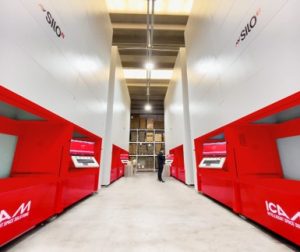
ICAM SILO² — multicolumn vertical lift module
SILO² is a multicolumn vertical lift module that stacks shifting trays across two opposing columns and delivers them to the operator on the goods to person principle. The multicolumn design is what separates it from single column VLMs: it handles items with a very high specific weight, from 113 to 1,001 kilograms per square metre, and recovers up to 90 per cent of floor area. It scales from 2 to 7 columns and up to 15 metres tall, with trays rated to 400 kilograms across 120 tray sizes. Two versions are offered: FAST for up to 30 per cent higher hourly throughput, ECO for around 20 per cent lower energy use. It is the pick for intensive storage of mixed small to medium items, from plastics and pharmaceuticals to steel moulds and mechanical components.
RIGO: multicolumn horizontal lift system
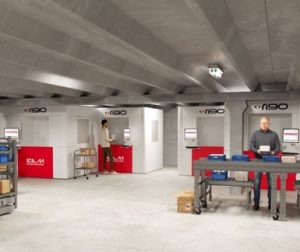
ICAM RIGO — multicolumn horizontal lift system
RIGO applies the same goods to person, shifting tray logic, but develops horizontally rather than vertically. That makes it the answer for low premises such as basements, low ceiling rooms, complex layouts and even outdoor sites, where a tall tower will not fit. It configures from 2 to 20 columns, up to 4.5 metres high and 20 metres wide, with trays rated to 105 kilograms for light and small to medium goods. Typical fits are manufacturing, distribution, medical and hospital stores, and retail back of house.
MAXI T: automatic tower storage for panels and sheet metal
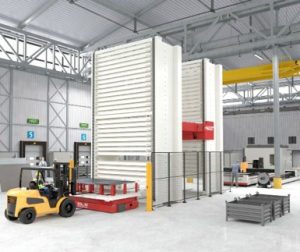
ICAM MAXI T — automatic tower storage for panels and sheet metal
MAXI T is an automatic tower vertical storage system built for panels, sheet metal and flat bulky materials. Drawers carry up to 3,000 kilograms across usable areas up to 4,100 by 2,100 millimetres, the tower reaches up to 12 metres, and it can cut storage footprint by as much as 90 per cent. It runs as a single tower or an opposing dual tower, indoors or outdoors, feeding sheet metal processing, laser cutting, furniture, HVAC, automotive and construction lines.
MAXI L: automatic vertical storage for long materials
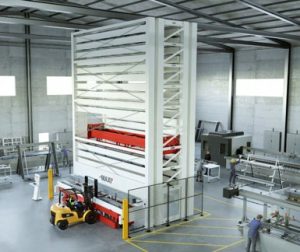
ICAM MAXI L — automatic vertical storage for long materials
MAXI L stores long, heavy and bulky materials, including bars, profiles, pipes, moulds, bundles and semi finished stock up to 7,100 millimetres long, in two opposing towers served by a central lift. Drawers are rated to 1,000 or 3,000 kilograms, the system carries up to 80 tonnes and rises to 15 metres, and it expands vertically through modular extensions as demand grows. It suits window and door fabrication, metalworking, automotive, furniture, lighting, plumbing and photovoltaic production, and integrates directly with cutting centres, presses, assembly lines and robots.
MAXI STC: stacker crane AS/RS for long goods
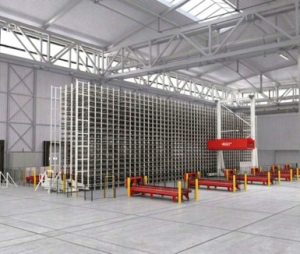
ICAM MAXI STC — stacker crane AS/RS for long goods
MAXI STC is an automated storage and retrieval system built on a stacker crane, engineered for high density handling of long goods up to 7 metres, such as profiles, bars, tubes and extrusions. It is the right step up from a drawer based tower once you are managing 400 or more load units, the point at which throughput and continuity become critical. The crane runs a fully automated cycle, handles two load units at once, and combines retrieval and delivery into a single movement to cut cycle times. Full traceability by code, batch and order is standard. It fits doors and windows, building and construction, furniture manufacturing, metalworking, and distribution at volume.
Compatta: mobile racking system
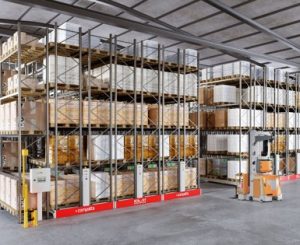
ICAM Compatta — mobile racking system
Compatta is a mobile racking system: racks mounted on motorised bases that travel along floor rails, opening an aisle only where an operator or forklift needs one. Removing fixed aisles lifts storage capacity by around 40 per cent in the same area, or recovers up to 80 per cent of space for the same stored volume. It adapts to new or existing pallet racking, cantilever racking and shelving, carries up to 1,200 tonnes per base, and operates in cold rooms down to minus 30 degrees Celsius, where reducing empty volume also cuts energy use.
One control platform across the range
All six systems run on ICON, ICAM’s proprietary web based console. It handles real time monitoring, automated load and unload missions, traceability by item code, batch and order, user permissions, operation logging and backup, and it maps ground level stock stored outside the automated units. Because ICON integrates with leading WMS and ERP platforms, a site can start with one system and add others later without a second control layer.
The ICAM range at a glance
| System | Type | Stores best | Standout capacity | Footprint benefit |
| SILO² | Multicolumn vertical lift module | Small to medium mixed items, dense loads | Trays to 400 kg; 113 to 1,001 kg/m² | Up to 90% floor saved; to 15 m tall |
| RIGO | Multicolumn horizontal lift | Light goods in low premises | Trays to 105 kg; 2 to 20 columns | Fits low ceilings; to 20 m wide |
| MAXI T | Automatic tower storage | Panels, sheet metal, flat bulky stock | Drawers to 3,000 kg | Up to 90% floor saved; to 12 m tall |
| MAXI L | Automatic vertical storage | Long profiles, bars, pipes, moulds | Drawers to 3,000 kg; system to 80 t | To 15 m tall; vertically expandable |
| MAXI STC | Stacker crane AS/RS | Long goods at high volume (400+ LUs) | Materials to 7 m; 2 LUs per cycle | High density vertical and longitudinal |
| Compatta | Mobile racking | Dense pallet and bulk storage | To 1,200 t per base; down to −30°C | +40% capacity in same area |
Frequently asked questions
What is a vertical lift module and how does it save floor space?
A vertical lift module (VLM) is an enclosed system of shifting trays served by a central lift that brings each tray to the operator on the goods to person principle. Because it stacks storage upward rather than across the floor, a unit like SILO² can recover up to 90 per cent of the floor area that conventional shelving would use, while reaching up to 15 metres tall. Operators pick and refill at a single station, which also cuts walking and search time.
What is the difference between a single column and a multicolumn VLM?
A single column module has one tray stack; a multicolumn module such as SILO² spreads trays across two or more columns under one lift. The multicolumn layout carries a much wider load range, handling items with a very high specific weight, from 113 to 1,001 kilograms per square metre, and scales from 2 to 7 columns in one machine. In practice that means denser storage and fewer separate units on the floor.
Which storage system works in a building with low ceilings?
RIGO is built for exactly that. It is a horizontal lift system that develops sideways rather than upward, so it fits basements, low ceiling rooms, complex layouts and outdoor sites where a tall tower cannot go. It configures up to 4.5 metres high and 20 metres wide, with 2 to 20 storage columns.
How do I store sheet metal and large panels efficiently?
MAXI T is an automatic tower storage system designed for panels, sheet metal and flat bulky stock. Its drawers carry up to 3,000 kilograms across usable areas up to 4,100 by 2,100 millimetres, and the tower can cut the floor footprint of that stock by as much as 90 per cent. It feeds directly into sheet metal processing and laser cutting lines, so material moves from storage to machine with minimal handling.
What is the best way to store long materials such as bars, profiles and tubes?
Two ICAM systems cover long stock. MAXI L stores bars, profiles, pipes, moulds and bundles up to 7,100 millimetres long in drawer style towers, and suits most fabrication and metalworking sites. Once you are handling 400 or more load units and need higher throughput, MAXI STC, a stacker crane system, is the stronger fit.
What is an AS/RS, and when is a stacker crane the better choice?
An automated storage and retrieval system (AS/RS) uses a machine that moves automatically to store and retrieve loads without an operator entering the racking. MAXI STC is a stacker crane based AS/RS for long goods up to 7 metres, and it becomes the right choice above about 400 load units, where speed and continuous operation matter most. It runs a fully automated cycle, handles two load units at once, and keeps full traceability by code, batch and order.
How does mobile racking increase storage capacity?
Mobile racking mounts racks on motorised bases that travel along floor rails, so only one working aisle opens at a time instead of an aisle between every row. Removing those fixed aisles lets Compatta lift storage capacity by around 40 per cent in the same area, or recover up to 80 per cent of space for the same stored volume. It works with new or existing pallet racking, cantilever racking and shelving.
Can these systems operate in cold rooms and freezers?
Yes. Compatta is rated for cold rooms down to minus 30 degrees Celsius, and by removing empty aisle volume it also reduces the space that has to be kept cold, which cuts energy use. The automated storage systems run in standard working environments from 0 to 40 degrees Celsius as standard, with options available for more demanding conditions.
How much weight can each ICAM system handle?
Capacity scales with the technology. Vertical lift module trays carry up to 400 kilograms (SILO²) and horizontal lift trays up to 105 kilograms (RIGO); tower and long material drawers carry up to 3,000 kilograms (MAXI T and MAXI L), with MAXI L systems rated to 80 tonnes overall. Mobile racking carries the heaviest loads, up to 1,200 tonnes per mobile base (Compatta).
Do ICAM storage systems integrate with WMS and ERP software?
Yes. Every system runs on ICON, ICAM’s web based console, which is built to integrate with leading WMS, ERP and other enterprise platforms. ICON also maps ground level stock held outside the automated units, so inventory across the whole site stays in one view.
Can automated storage be installed outdoors?
Several can. SILO², RIGO, MAXI T and MAXI L are all designed for indoor or outdoor installation, which helps when internal floor space is scarce or when you want to limit the visual footprint inside a facility. A site assessment confirms the right weather protection and configuration for an outdoor unit.
Can the system be expanded as storage needs grow?
Yes. MAXI L expands vertically through modular extensions, SILO² and RIGO scale by adding storage columns, and Compatta lets you add mobile bases over time. That means you can size a system to current volumes and grow it later without replacing the core installation.
How much floor space can I reclaim with automated storage?
It depends on the technology and your current layout. Vertical lift modules and tower systems typically recover up to 90 per cent of the floor area used by conventional shelving, by building upward instead of outward. Mobile racking takes a different route, adding around 40 per cent more capacity in the same area or freeing up to 80 per cent of space for the same stored volume.