A single column vertical lift module can transform a parts store. But density, weight and throughput eventually catch up. Here is how to read the warning signs, and what Australian operations move to next.
By the SmartlogitecX Australia editorial team. Technical figures verified against ICAM product documentation for SILO², MAXI L, MAXI T and MAXI STC.
Vertical lift modules quietly reshaped the modern warehouse. Instead of walking aisles, an operator stands at one opening while the machine brings trays of parts to them. Floor space shrinks, picking speeds up, and inventory finally stays in order. ICAM is one of the familiar names in this category, and for thousands of operations a standard single column unit does exactly what it promises.
Then something shifts. The parts list keeps growing. Trays start coming out heavy. A queue forms at the picking window during the morning rush. The machine that once solved the storage problem begins to feel like the bottleneck.
This is the moment many Australian warehouses reach without expecting it. The issue is rarely a faulty machine. It is a question of architecture. A single column of trays has a fixed ceiling on how much weight and density it can hold, and once an operation presses against that ceiling, bolting on another identical unit is not always the smartest move. A well specified vertical system can recover as much as 90 percent of the floor a conventional layout uses, but only if the format actually fits the stock.
Here is what really drives a warehouse to outgrow a standard vertical lift module, the numbers worth measuring, and the systems operations turn to when one column is no longer enough.
» MORE: What is an automated storage and retrieval system?
What is a standard vertical lift module?
A vertical lift module, usually shortened to VLM, is an enclosed automated storage system built around a single column of trays served by a central lift. When an operator requests an item, the lift retrieves the correct tray and delivers it to a picking opening at waist height. The principle is called goods to person, because the stock travels to the worker rather than the worker travelling to the stock.
The appeal is easy to see. A VLM uses the full height of a building, so a footprint that once held a few shelving bays can hold thousands of items. Picking errors fall because the machine points the operator to the exact tray and location. And because the stock sits behind a shutter, it stays clean, secure and traceable.
Standard single column units, the format most buyers picture when they think of a VLM, suit small and medium parts at steady volumes. Fasteners, electronic components, spares, tooling and pharmaceuticals all sit comfortably in this world. The limits only appear when an operation pushes past the profile the machine was designed for.
Why do warehouses outgrow a standard VLM?
Growth rarely announces itself. It arrives as a run of small frustrations that, taken together, point to the same conclusion. Three pressures do most of the work.
The first is density. A single column can only hold so much weight per square metre of stored goods before the structure is fully committed. High turnover operations that keep adding lines run out of usable tray space long before they run out of ambition, and consolidation eventually stops buying room.
The second is weight. Every tray has a rated capacity, and heavy items such as steel components, moulds and dense mechanical parts eat into that budget quickly. When trays are routinely loaded near their limit, the machine is telling you something.
The third is throughput. A single column serves one lift and, usually, one or two picking openings. During peak periods, orders bank up while the lift shuttles back and forth. The storage is fine. The flow is not.
There is a fourth, quieter trigger. Sometimes the material was never a good fit for a parts VLM in the first place. Bars, tubes, profiles, panels and sheet metal do not belong in a small parts machine, and no amount of extra columns will fix that mismatch.
Three signs it is time to move on
If you are weighing up whether your current system has run its course, these are the practical signals to look for.
- Your trays are full but the SKU list keeps growing. When new lines have nowhere to go and consolidation no longer frees space, you have hit a density wall rather than a housekeeping problem.
- You are loading trays close to their weight limit. Rated tray capacity on many systems tops out around 400 kg. If your team is regularly near that figure, a denser or heavier duty format will pay for itself in reliability alone.
- Pickers are queuing at the opening. A single lift and one picking window can only move so many lines per hour. When operators wait on the machine during peak, throughput, not storage, is the constraint.
A useful rule of thumb: if two of these three signs are present most weeks, the operation has outgrown a standard single column unit.
» MORE: Automated storage systems for Australian warehouses
How multiple columns change the maths
The most direct answer to a density and throughput ceiling is not another single column machine. It is a system that runs several storage columns behind one coordinated structure. ICAM’s SILO², supplied in Australia by SmartlogitecX, is built on exactly this idea.
Rather than one column, SILO² can be configured with anywhere from two to seven storage columns, reaching heights of up to 15,000 mm. That range matters, because it lets the system scale with the operation instead of forcing a rip and replace when volumes climb. The same ICAM design adapts to low ceilings, underground spaces, multi level layouts and even outdoor installations, which is a genuine advantage on Australian sites where clear height and yard space vary widely.
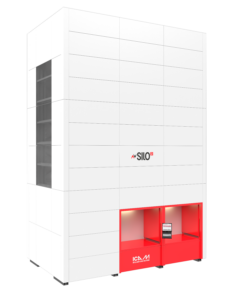
The number that separates a multiple column system from a standard one is density. SILO² supports a specific load capacity ranging from 113 up to 1,001 kg per square metre, with trays rated to a maximum of 400 kg. In plain terms, it holds far more weight in the same volume than a single column can, which is the whole point when your parts are dense and your catalogue keeps expanding. With more than 120 tray sizes and a range of internal dividers, the system fits the actual mix of items rather than forcing everything into one format.
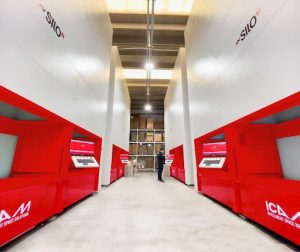
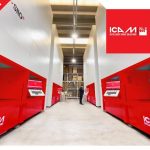
SILO² multiple column vertical lift module in operation, with picking stations on both sides. Image: ICAM.
Throughput scales too. SILO² can carry between one and eight picking stations, so while an operator works at one opening the machine is already preparing the next tray at another. It arrives in two builds. The FAST version delivers more than a 30 percent lift in trays handled per hour, while the ECO version trims overall energy use by around 20 percent. Same trays, same capacity, two answers depending on whether speed or running cost drives your business case.
Safety and control are built in rather than bolted on. Multi ray light curtains, an automatic shutter door and emergency stops protect the operator at the picking station, while the ICON software coordinates retrieval, tracks stock by code and batch, and integrates with common WMS and ERP platforms. The result is a system that recovers up to 90 percent of the floor space a conventional layout would use, without giving up oversight of what is stored where.
| SILO² specification | Figure |
| Storage columns | 2 to 7 |
| Maximum height | Up to 15,000 mm |
| Maximum tray load | 400 kg |
| Specific load capacity | 113 to 1,001 kg per square metre |
| Tray sizes available | More than 120 |
| Picking stations | 1 to 8 |
| Throughput | 53 to 87 trays per hour, depending on version |
| Floor space recovered | Up to 90 percent |
Source: ICAM SILO² technical documentation. Figures are indicative and configuration dependent.
When it is not a small parts problem at all
Sometimes the honest answer is that a parts VLM was never the right tool. If your stock is long, flat or genuinely heavy, the move is sideways into a format designed for it, rather than up into a denser parts machine. Three ICAM systems cover that ground.
MAXI L for long materials
MAXI L is the automated vertical store for long stock. It handles bars, tubes, profiles, semi finished materials, moulds and tooling up to 7,100 mm in length, with drawers rated to 1,000 or 3,000 kg. Built as two facing towers with a central lift, it installs indoors or outdoors and expands in height through the extensions as the operation grows. For window, curtain wall, HVAC and metal fabrication businesses, this is the system that finally gets long stock off the floor and out of the aisles.
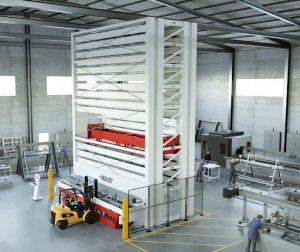
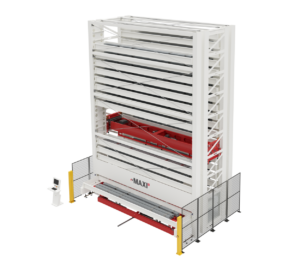
MAXI L automated vertical storage for long materials such as bars, tubes and profiles. Image: ICAM.
MAXI T for panels and sheet metal
MAXI T is the tower store for panels and sheet metal. Available as a single or double tower, it stores flat and bulky materials with drawers rated to 3,000 kg and recovers up to 90 percent of floor space. It slots neatly beside cutting centres and laser machines, feeding flat stock into production while protecting the material from the dents and scratches that manual handling causes.
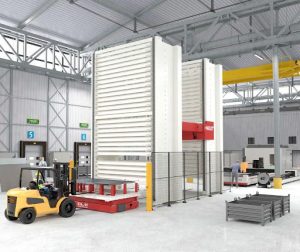
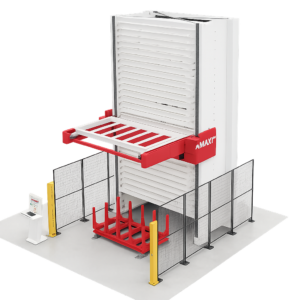
MAXI T automated tower storage for panels and sheet metal, feeding a laser cutting cell. Image: ICAM.
MAXI STC for high volume long goods
MAXI STC steps up again. It is an automated storage and retrieval system built on a stacker crane, designed for operations managing more than 400 load units of material up to 7 metres long. It handles two load units at once and runs a fully automated cycle, which keeps a busy fabrication plant moving when manual retrieval would grind it to a halt.
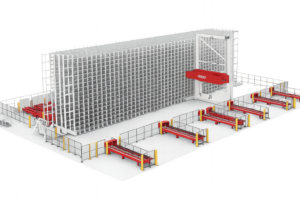
A quick way to match material to machine:
- Small and medium parts at high turnover: SILO²
- Long stock such as bars, tubes and profiles: MAXI L
- Panels and sheet metal: MAXI T
- More than 400 load units of long goods: MAXI STC
» MORE: Automated tower storage for panels and sheet metal
What does this look like in an Australian warehouse?
The pressures above are not abstract. Australian fabricators working with aluminium and steel profiles, window and curtain wall manufacturers, HVAC ducting shops and sheet metal businesses all deal with stock that is either dense, long or awkward. Many are also working in high clearance sheds where the most underused asset is the empty air above the racking.
That combination is exactly where vertical storage earns its keep. Reclaiming height turns wasted volume into working capacity, and outdoor rated configurations suit sites where floor area is at a premium but yard space is available. For operations comparing options locally, the practical questions are less about brand and more about fit. What does the stock weigh, how long is it, how fast does it move, and how much room is there to grow.
One point on comparisons. Naming a familiar brand such as ICAM is a fair way to describe the single column category, but a buying decision should rest on measured requirements rather than reputation. Under Australian Consumer Law, any comparison you publish or rely on should be truthful and able to be substantiated. The right system is the one that matches your material profile and throughput, and that answer differs from one warehouse to the next.
How to decide with confidence
Choosing a replacement or an upgrade does not need to be a leap of faith. A short, disciplined process removes most of the risk.
- Measure before you shop. Record your SKU count, typical and peak tray weights, and lines picked per hour at busy times. These three figures decide almost everything.
- Sort your stock by material class. Separate small parts from long stock, panels and heavy items. A mixed profile often needs more than one format.
- Size at the quoting stage. A well specified system is matched to your real load requirements, so you avoid paying for structure you will never use.
- Weigh speed against running cost. If peak throughput drives the business case, favour a faster build. If energy and long term cost matter more, a lower consumption version may win.
- Plan the integration. Confirm how the system talks to your WMS or ERP, and how stock will be tracked by code and batch.
- Leave room to grow. Choose a format that expands, whether through extra columns or vertical height, so the next capacity jump is an upgrade rather than a replacement.
The bottom line
A standard vertical lift module is a fine machine that eventually meets a ceiling built into its single column design. Outgrowing it is a sign of success, not a mistake. The task is to read the signals early, measure honestly, and match the next system to the stock you actually store. For most Australian operations that means a denser multiple column system such as SILO², or a format built for long and flat materials, chosen on the numbers rather than the nameplate.
Frequently asked questions
What is the difference between a single column and a multiple column vertical lift module?
A single column unit stores trays in one column served by one lift, which caps how much weight and density it can hold. A multiple column system such as SILO² runs from two to seven columns behind one structure, so it stores far more in the same volume and can serve several picking stations at once.
How much weight can a VLM tray hold?
On SILO² the maximum tray load is 400 kg. The system also supports a specific load capacity of up to 1,001 kg per square metre, which is why it suits dense and heavy parts that would overwhelm a lighter single column unit.
When should I move from a standard VLM to a larger system?
The clearest triggers are full trays alongside a growing SKU list, trays routinely loaded near their weight limit, and pickers queuing at the opening during peak. If two of those three appear most weeks, the operation has usually outgrown a standard unit.
Can vertical storage systems be installed outdoors?
Yes. SILO² and the MAXI range can be configured for outdoor installation, which suits Australian sites where floor area is tight but yard space is available. Components can be specified for wider temperature and humidity conditions on request.
What is goods to person picking?
Goods to person means the storage system brings the required tray or drawer to the operator at a fixed station, rather than the operator walking to the stock. It cuts travel time, reduces errors and improves safety.
Which system suits long materials such as bars and profiles?
MAXI L is designed for long stock up to 7,100 mm, including bars, tubes, profiles and semi finished materials, with drawers rated to 1,000 or 3,000 kg. It is a better fit than a parts VLM whenever the material is long rather than small.
How do I store panels and sheet metal vertically?
MAXI T is the tower system for panels and sheet metal, with drawers rated to 3,000 kg and up to 90 percent floor space recovery. It feeds flat stock into cutting and laser operations while protecting the material from handling damage.
What happens when I manage more than 400 load units of long goods?
At that scale MAXI STC, an automated storage and retrieval system built on a stacker crane, is the intended solution. It manages long goods up to 7 metres, handles two load units at once and runs a fully automated cycle to keep high volume operations moving.
Will an automated storage system integrate with my existing software?
Every ICAM system runs on ICON, a web based platform that tracks stock by code, batch and order and integrates with common WMS and ERP systems, so the storage sits inside your existing inventory processes rather than beside them.
How much floor space can vertical storage recover?
Well specified vertical systems can recover up to 90 percent of the floor area a conventional layout would use, by turning unused building height into working storage capacity.
About this guide. Technical specifications are drawn from ICAM product documentation for SILO², MAXI L, MAXI T and MAXI STC. SmartlogitecX Australia is the Australian supplier of ICAM automated storage systems. Figures are indicative and configuration dependent; confirm specifications for your site during quoting.