Automated vertical storage can pay for itself, but the return depends far more on your labour bill and your rent than on the machine itself. Here is how Australian facilities work out what they will actually get back.
If you are weighing up a vertical carousel, a vertical lift module or a larger automated storage and retrieval system, the first honest thing to say is that there is no sticker price. Anyone who quotes a single figure for “a vertical storage system” without asking about your building, your stock and your order volumes is guessing. The return on one of these systems is built from your own numbers, not the vendor’s.
The drivers, though, are well understood, and most of them are easy to estimate before you ever request a quote. Two facts frame the whole business case. In a typical manual operation, walking and searching can account for around half or more of a picker’s time, so you are paying people to move rather than to pick. And body stressing, which includes manual handling, is consistently the most common cause of serious workers compensation claims in Australia, according to Safe Work Australia. Vertical storage speaks directly to both.
Here is what you need to know about what these systems return, how to turn each driver into a rough payback, and when a vertical system is the wrong call. The technical figures throughout come from the manufacturer specifications for the ICAM range that SmartlogitecX supplies in Australia, so they are verifiable rather than rounded up for effect.
» MORE: A plain guide to automated storage systems
First, work out which machine you are actually pricing
“Vertical carousel” and “vertical lift module” get used as if they mean the same thing. They do not, and the difference matters for both cost and return.
- Vertical carousel: A loop of shelves or bins rotates around a track and brings the right one down to an operator at a fixed window. It suits smaller, lighter items and steady picking.
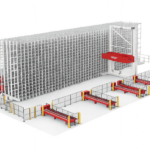
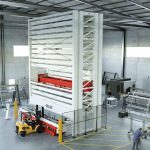
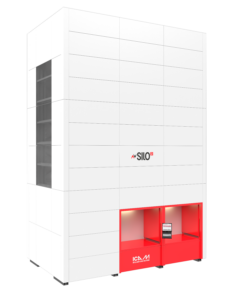
- Vertical lift module: Trays sit still in two facing columns and a single lift travels up the middle to fetch whichever tray you ask for. The SILO² that SmartlogitecX supplies works this way, and can be built with anywhere from two to seven columns and up to 15 metres tall, which is why it suits sites with height to spare but little floor.
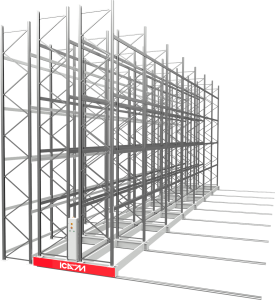
- Automated storage and retrieval system: A bigger step again. The MAXIˢᵗᶜ stacker crane, for instance, is built for operations moving 400 or more load units and runs a fully automated cycle with no operator inside the aisle. It costs more and returns more, but only if your volumes justify it.
Which of the three fits you comes down to three questions: how large and heavy your stock is, how many order lines you pick an hour, and how much clear height your building offers. A site with 12 metres of unused roof and thousands of small parts is a very different proposition from a low warehouse full of pallets, and the return follows the fit. Get the match wrong and even a well priced machine will disappoint, which is why the smartest buyers settle the system type before they ever talk about price.
The five things that decide your return
Payback on automated vertical storage is built from five drivers. For most Australian warehouses, the first two do the heavy lifting, but a proper business case counts all five.
1. Labour is usually the biggest saving
In a conventional warehouse, pickers spend most of their shift walking and searching rather than picking. Goods to person storage reverses that. Instead of the operator walking to the stock, the tray comes to the operator at an ergonomic window, often with a light pointing at the exact bin to pick. The SILO² delivers between 53 and 87 trays an hour depending on how it is configured, and one operator can run several units side by side, so a large pick face collapses into a single station.
To size the saving, take the number of full time equivalent pickers you could redeploy, multiply by their fully loaded annual cost, and you have your labour line. In Australia, where wages, casual loadings and superannuation push the real cost of a picker well beyond the base rate, this is almost always the largest single figure in the case, and it compounds across shifts, so a two shift or three shift operation multiplies the saving accordingly. It is worth counting the softer labour effects too, from lower recruitment and training churn on a job that is easier on the body to the supervision time you no longer spend chasing lost stock. If picking labour is only a small part of your operation, be honest with yourself, because the machine will take longer to pay back.
2. The floor space you get back
Because a vertical system stacks upward rather than sprawling outward, it turns unused ceiling height into storage. ICAM rates the SILO² footprint saving at up to 90 per cent against an equivalent shelving layout, with around 80 per cent of the original floor recovered.
What that floor is worth depends entirely on where you are. In the industrial markets around Sydney, Melbourne and Brisbane, where rent per square metre has climbed hard and vacancy is tight, recovered space can be the difference between staying put and funding a costly move. Some operators sublet it, some convert it to production or value added work, and some simply use it to defer an expansion they could not otherwise afford. Any of those outcomes belongs in the calculation, and in high rent postcodes the space line can rival the labour line.
3. Accuracy you can bank
Errors are quieter than labour and rent, but they add up. Every mispick becomes a return, a redelivery, a credit and an unhappy customer, and in regulated sectors such as pharmaceuticals or aerospace parts it can be far worse. Goods to person systems cut picking errors sharply because the machine presents one tray, points to one location, and can confirm the pick. The ICON software behind the ICAM range tracks every item by code, batch and order, which gives you traceability that manual shelving cannot. Put a realistic cost on your current error rate, estimate how far a guided system would cut it, and add that to the return. Most facilities are surprised how large this line becomes once they count the full cost of getting an order wrong.
4. Energy use, smaller but real
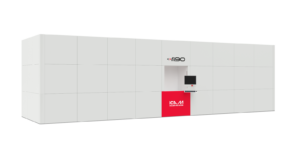
Automated warehouse systems draw power, and it is fair to count it. The honest framing is that the SILO² offers a choice: a FAST configuration that lifts hourly throughput by about 30 per cent, or an ECO configuration that cuts energy use by around 20 per cent, with installed power of roughly 11 to 14 kilowatts depending on which you pick. For a throughput constrained site, the faster option usually earns back its extra energy many times over in labour. For a site chasing lower running costs or sustainability targets, the ECO path makes sense. Either way, energy is a modest line next to labour and space, but it belongs in the model rather than being waved away.
5. The injuries you never have
Manual handling is one of the most common causes of serious workplace injury in Australian warehouses, and each incident carries real cost in claims, lost time and premiums, quite apart from the human toll. Under Work Health and Safety obligations, reducing that exposure is not optional. Vertical systems bring stock to the operator at a set height, which removes a great deal of bending, reaching and lifting from the task. The equipment itself is guarded, with light curtains, automatic shutters and emergency stops on the SILO², and fully enclosed aisles on the stacker crane systems. You will not find a precise figure for an injury you did not have, but a conservative estimate from your own claims history is a legitimate, and often meaningful, part of the return.
» MORE: What Australian warehouses should check before investing
How to estimate your own payback
You do not need a vendor to sketch a rough payback. Add up the five drivers as annual savings: picking labour redeployed, floor space recovered and valued at your rent, error cost avoided, any energy difference, and a conservative injury saving. That total is your annual return. Divide the likely system cost by that number and you have a payback in years.
To make that concrete, picture a mid sized operation running a busy pick face with eight staff across a shift. If a vertical setup lets you redeploy five of them to higher value work, and each carries a fully loaded cost in the tens of thousands of dollars a year, the labour line alone runs into the hundreds of thousands annually before you add anything else. Layer on the floor you reclaim, valued at your own rent per square metre, and the error cost you stop absorbing, and the annual return often lands in a range that recovers the equipment within a small number of years. Swap in your own headcount, your own rent and your own error rate, and the picture sharpens fast. The point of the exercise is not the exact figure but the order of magnitude, which is usually enough to tell you whether the conversation is worth having.
Because the machine price varies so much with height, column count, tray sizes and throughput, the sensible move is to build the savings side first, decide what payback period your business would accept, and only then ask a supplier to quote against it. Facilities with heavy picking labour and expensive floor space tend to reach an attractive payback comfortably, while low volume operations with cheap space should expect a longer wait. A local assessment against your actual stock profile will always beat a figure pulled from a web page, including this one.
When your volume calls for a full system
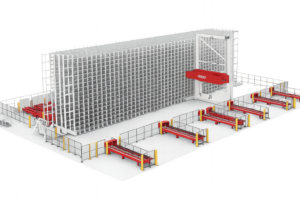
There is a point where a single vertical unit stops being the right tool. Once you are managing hundreds of load units and picking around the clock, a stacker crane based system such as the MAXIˢᵗᶜ starts to make more sense. It handles two load units at once, runs a fully automated cycle, and combines putting stock away and retrieving it into a single movement so the crane is rarely travelling empty. The capital is higher, but so is the throughput, and above roughly 400 load units the maths often tips in its favour. If you are not sure which side of that line you sit on, the same principles apply, and it is worth reading what an automated storage and retrieval system actually is before you shortlist anything.
Long and bulky stock is a different case
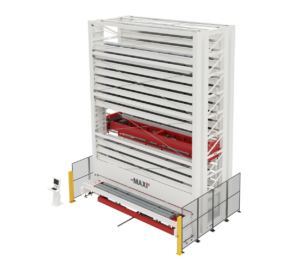
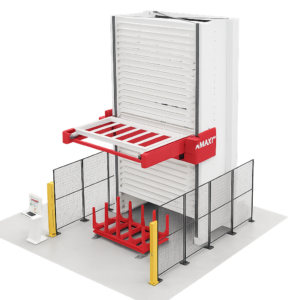
Not everything fits in a tray. If your business stores long profiles, bars, tubes, sheet metal or panels, the return comes from different machines and slightly different logic. The MAXIᴸ handles long materials up to 7,100 millimetres and feeds them straight to cutting centres and presses, while the MAXIᵀ tower stores sheet and panel stock and can reclaim up to 90 per cent of the floor those materials used to occupy. For fabricators, the return is as much about protecting expensive material and speeding up how fast it reaches the machine as it is about picking labour.
When automated vertical storage is not worth it
For all the upside, these systems are not for everyone, and a good supplier will tell you so. If your picking volumes are low, if your stock is large and irregular, or if space is genuinely cheap where you operate, the payback can stretch to the point where the money is better spent elsewhere. Automation also asks something of your processes and your team, and dropping a machine into a disorganised operation rarely fixes the disorganisation. The clearest sign that a vertical system will pay is a busy pick face, tight and expensive floor, and stock that suits a tray. The clearer that picture, the faster the return.
The bottom line
Automated vertical storage pays back when your own numbers say it should, not because a brochure promises it will. Build the five drivers from your labour bill, your rent, your error rate, your energy and your safety record, and you will have a business case that stands up in front of a finance director. The manufacturer figures give you a reliable read on what the machines can do; your operation decides what that is worth. If the labour and floor space lines look large, a vertical carousel or lift module is well worth costing properly, and it is worth seeing a SILO² vertical lift installation to picture what that looks like in a real facility.
Frequently asked questions
How much does a vertical lift module cost in Australia?
There is no fixed price. Cost depends on height, the number of columns, tray sizes, throughput and how the system connects to your software. Rather than chasing a list price, estimate your own payback from labour, space, accuracy, energy and safety, then ask a supplier to quote against it. A local assessment on your stock profile gives the firmest figure.
What is a typical payback period?
It varies widely. Facilities with heavy picking labour and expensive floor space often reach an attractive payback within a few years, while low volume sites with cheap space wait longer. The honest answer is that your labour bill and your rent decide it, so build the savings side before comparing any quote.
Is a vertical carousel or a vertical lift module better?
Neither is better in the abstract. A carousel rotates shelves to the operator, while a lift module keeps trays still and sends a lift to fetch them. Lift modules such as the SILO² tend to suit taller buildings and mixed tray sizes, and scale from two to seven columns. The right choice depends on your stock, your throughput and your clear height.
How much floor space can a vertical lift module save?
ICAM rates the SILO² at up to 90 per cent footprint saving against an equivalent shelving layout, recovering around 80 per cent of the original floor. The exact figure depends on your ceiling height, since the whole point is trading floor area for vertical space.
How much does an automated storage and retrieval system cost?
More than a single vertical unit, because it is a larger installation built for higher volumes. A stacker crane system such as the MAXIˢᵗᶜ suits operations handling 400 or more load units. As with smaller systems, cost is driven by size, height and throughput, so a scoped quote is the only reliable number.
Do these systems really cut labour costs?
Yes, when picking labour is a real part of your operation. Goods to person storage removes most of the walking and searching from picking, so one operator can run several units at once and a large pick face collapses to a single station. If you barely pick, the labour saving is small and the payback is slower.
How fast can a vertical lift module pick?
The SILO² delivers between 53 and 87 trays an hour depending on whether it is set up in ECO or FAST configuration. Throughput at the pick face also depends on how you batch orders and how many stations you run.
Are vertical storage systems safe?
They are designed to reduce manual handling risk, a leading cause of warehouse injury in Australia. Units include guarding such as light curtains, automatic shutters and emergency stops, and stacker crane systems fully enclose the operating aisle. Because stock arrives at a set height, they also cut bending and heavy lifting from picking.
Can a vertical system connect to our WMS or ERP?
Yes. The ICAM range runs on ICON software, which integrates with common warehouse and enterprise systems and tracks every item by code, batch and order. That link is part of the return, because it improves inventory accuracy alongside picking.
When is automated vertical storage not worth it?
When picking volumes are low, stock is large and irregular, or floor space is genuinely cheap. In those cases the payback can stretch out and the money may be better spent elsewhere. Automation also will not fix a disorganised operation on its own.
About these figures
The technical specifications in this article are drawn from ICAM manufacturer documentation for the SILO², MAXIᴸ, MAXIᵀ and MAXIˢᵗᶜ systems supplied in Australia by SmartlogitecX, and describe manufacturer rated capabilities. Safety context references Safe Work Australia. Actual results depend on your building, stock and order profile; treat the payback method here as a planning framework, not a quote.