A vertical lift module can hand a 400 kg tray of parts to an operator in under a minute and give back most of the floor it once occupied. Here is how the machine actually moves, and how to tell one type of vertical store from another.
Walk into most manufacturing sites and you find the same quiet waste. Metres of shelving, the space above head height left empty, and staff spending part of every shift walking to stock rather than working on it. Vertical storage automation exists to solve both problems at once, yet the way these machines work is rarely explained in plain terms.
This piece looks at the mechanics. It follows a tray from its slot in the column to the operator’s hands, explains why a vertical lift module can recover most of the floor a conventional store needs, and sets out the real differences between the systems that get grouped together under one label. The figures used throughout are drawn from ICAM’s published product data for its SILO², MAXI T, MAXI L and MAXI STC ranges.
What is a vertical lift module?
A vertical lift module, or VLM, is an enclosed automated store that keeps goods on trays inside tall columns and delivers those trays to a person on demand. It runs on a principle borrowed from modern warehousing: goods to person. Rather than sending an operator to walk the aisles, the machine brings the right tray to a fixed picking station at a comfortable working height.
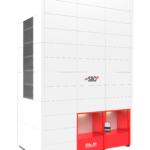
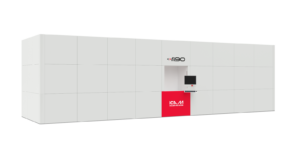
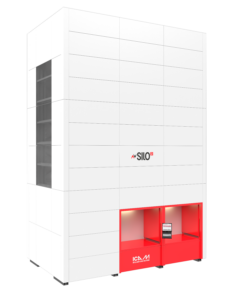
ICAM’s SILO² is a clear example. It stacks shifting trays in two opposing columns with a lift running between them, and it can be built with anywhere from two to seven columns reaching heights of up to 15 metres. Each tray carries up to 400 kg, and the system is offered in around 120 tray sizes, so the store can be matched to what a business actually holds, from fasteners and electronic components to steel moulds. Because the trays sit inside a sealed structure, stock stays clean, secure and traceable in a way open racking cannot manage.
» MORE: See ICAM’s SILO² multi column vertical lift module
How a vertical lift module delivers a tray, step by step
The tray delivery motion is the heart of the machine, and it happens along three axes. In SILO² these are the vertical Y axis, the horizontal X axis and the tray handling Z axis. Here is the sequence a single retrieval follows.
- The request. An operator calls up an item at the picking and refilling station, or the request arrives automatically from the warehouse automation software. The machine looks up which tray holds that item and where it sits in the column.
- The lift travels (Y). A central elevator rises or descends along the vertical axis until it is level with the target tray. This vertical travel is where the height of the building is turned into usable storage.
- The tray is drawn out (Z). A retrieval device engages the tray and slides it out of its slot onto the elevator along the tray handling axis. The trays are thin, only 41 mm high, so a great many can be packed into a single column.
- The tray is presented (X). The elevator carries the tray down and across to the picking and refilling station, delivering it at a loading height of 675 mm so the operator can reach in without stooping or stretching.
- The tray goes back. Once picking or refilling is done, the machine returns the tray to its slot, closes the automatic shutter door and stages the next mission.
The whole cycle runs without anyone entering the storage area. That is what makes the machine fast and, as covered below, safe.
Why the airspace above your head is the real prize
The headline benefit of vertical storage is floor space, and the figures are large. ICAM quotes up to 90% surface reduction, with around 80% of floor area recovered on a typical install. A single SILO² footprint of roughly 8 metres high, 3 metres deep and 7.1 metres wide can replace a floor store measuring about 13 by 7.5 metres.
Height alone does not explain that. The bigger gain comes from how tightly the machine packs trays. In its automatic configuration, SILO² spaces each tray to the actual height of the load it carries rather than to a fixed gap. With a positioning increment of 50 mm and a minimum tray spacing of 100 mm, the store closes up the dead air that fixed shelving leaves between levels. On a machine reaching 15 metres, that recovered airspace adds up quickly.
There is a second, less obvious point about capacity. SILO² is rated not only by tray load but by specific load capacity, from 113 up to 1,001 kg per square metre depending on tray size. That range, which ICAM presents as a point of difference from single column systems, matters for anyone storing dense items such as nuts and bolts or steel components, where the true limit is weight per area rather than volume.
Tray, drawer or load unit: three ways to store vertically
Not every tall automated store is a vertical lift module, and the differences are practical rather than academic. ICAM’s range is a useful way to see them, because it covers three distinct mechanisms.
Tray based VLM (SILO²). This is the true vertical lift module described above. Thin trays, goods to person, best suited to mixed discrete parts up to 400 kg per tray and to high picking frequency.
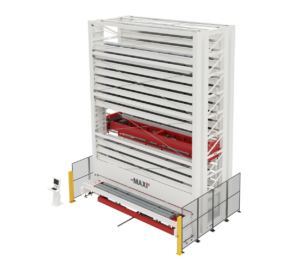
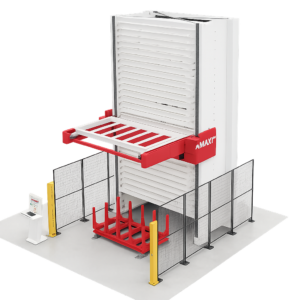
Drawer towers (MAXI T and MAXI L). These automatic tower stores use a lift to bring a large drawer, not a tray, to a load station. MAXI T is built for panels, sheet metal and bulky flat stock, with drawers rated to 3,000 kg and towers up to 12 metres tall. MAXI L handles long and heavy materials, storing profiles, tubes, bars and moulds up to 7,100 mm in length, and it can feed cutting centres, presses and assembly lines directly on a just in time basis.
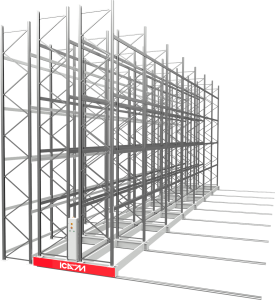
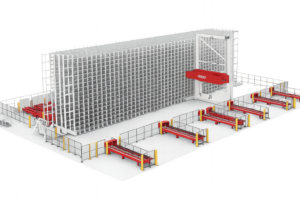
Stacker crane AS/RS (MAXI STC). This is a different class again. Instead of a self contained cabinet, a stacker crane runs inside an aisle between racking, moving steel load units of long goods up to 7 metres. ICAM positions it for operations managing 400 load units or more, handling two units at once on a fully automated cycle. It is the answer to high volume long goods storage, not to mixed small parts.
Choosing the wrong class is the costliest mistake in this field. A business with a few thousand small SKUs does not need a stacker crane, and a fabricator moving 7 metre extrusions cannot use a tray VLM. Match the mechanism to the material first, then size for volume.
» MORE: Compare ICAM’s full range of vertical storage systems
How fast is a vertical lift module, really?
Throughput is where expectations often slip. A VLM is quick, but its speed depends on the version and on how the picking stations are arranged.
SILO² comes in two builds. The ECO version handles 53 to 75 trays per hour and draws 11 kW. The FAST version handles 72 to 87 trays per hour and draws 14 kW, delivering more than a 30% lift in hourly performance for the same tray size and capacity. Businesses focused on running cost can take the ECO route, which ICAM rates at around 20% lower energy consumption.
The other lever is continuity. A SILO² can be fitted with up to eight picking and refilling stations, placed on the same level, on different levels or on opposite sides. Side by side stations let an operator keep working: while one tray is being picked, the machine already has the next mission staged at the neighbouring station. A sustained pick rate comes from that overlap far more than from raw lift speed.
Staying safe at the picking face
Because the moving parts sit inside a sealed structure, the operator never shares space with the lift. SILO² uses multi ray photoelectric light curtains and an automatic shutter door at the picking and refilling station, so the machine cannot present or move a tray while a hand is in the danger zone. Emergency push buttons on the front of the unit stop it instantly.
The principle carries across the range. On the MAXI STC stacker crane, the operating aisle is a protected zone with perimeter guarding, controlled access points and emergency stops, keeping staff clear of long, heavy loads in motion. For sites signing off new equipment, these are the details that satisfy safety and operations teams, not marketing claims.
The software that decides where every item lives
Hardware moves the tray; software decides which tray, and where each item belongs. Every ICAM system runs on ICON, a web based platform that integrates with WMS and ERP systems and provides traceability by item code, batch and order. It also maps floor level stock held outside the machine, so a manager sees total inventory rather than only what is inside the cabinet.
ICON brings tools that a spreadsheet cannot. ABC classification keeps fast movers nearest the picking face, dynamic association rules group items that ship together, and multi machine management and logged operations with automatic backup keep the whole store accountable. Alongside it, ICAM’s IRIDE workstation guides the operator with coloured light beams for each pick, a head up dashboard in the line of sight and adaptive lighting that flags alarms. Together they cut picking errors and shorten training, which is where a good part of the labour saving actually comes from.
Which vertical storage system fits your stock?
The mechanism decides the shortlist. These rules of thumb are a sensible place to start.
- Mixed small to heavy parts, high pick frequency: a tray based VLM such as SILO². Think fasteners, electronics, pharmaceuticals, tooling and moulds up to 400 kg per tray.
- Sheet metal and panels: a drawer tower such as MAXI T vertical storage, with drawers rated to 3,000 kg.
- Long profiles, tubes and bars up to 7.1 metres at moderate volume: MAXI L, ideally feeding a cutting or machining line.
- High volume long goods, 400 load units or more: a MAXI STC stacker crane.
There is also a case for not automating. If a business holds a small number of SKUs and picks them rarely, conventional racking may still be the sensible choice. The return on a VLM comes from picking frequency, storage density and the value of the floor it frees. The honest question is not whether the technology is impressive, but whether the volume and the property justify it.
» MORE: Talk to SmartLogitecX about which ICAM system suits your site
Frequently asked questions
How does a vertical lift module deliver a tray?
It moves along three axes. A central lift rises to the tray’s level (vertical), a retrieval device slides the tray onto the lift (tray handling), and the lift carries it to a picking station at a set working height (horizontal). The tray returns to its slot once picking is finished.
What is the difference between a vertical lift module and a vertical carousel?
A VLM uses a lift to fetch stationary trays from fixed columns, so it can reach any tray on the shortest path. A carousel rotates a loop of shelves or bins past a fixed opening, so it must turn until the right shelf arrives. VLMs generally handle taller buildings and heavier, more varied loads.
How much floor space can a vertical lift module save?
ICAM quotes up to 90% surface reduction, with around 80% of floor area recovered on a typical install. A single SILO² footprint of about 8 by 3 by 7.1 metres can replace a floor store of roughly 13 by 7.5 metres.
How heavy a load can a VLM tray hold?
SILO² trays carry up to 400 kg each. Because dense items are limited by weight per area rather than volume, the system is also rated by specific load capacity, from 113 up to 1,001 kg per square metre depending on tray size.
h3How many trays per hour can a vertical lift module handle?
It depends on the build. SILO² ECO manages 53 to 75 trays per hour; SILO² FAST manages 72 to 87, more than 30% faster for the same tray size. Fitting several picking stations side by side keeps the rate steady through a shift.
What is goods to person picking?
It is an order picking method in which the storage system brings items to a stationary operator, rather than the operator walking to the stock. It reduces travel time, improves accuracy and lets picking happen at a safe, ergonomic height.
Can a vertical storage system hold long materials like bars and profiles?
Yes, but not with a tray VLM. ICAM’s MAXI L stores long and heavy materials up to 7,100 mm in drawers, and its MAXI STC stacker crane handles long goods up to 7 metres for high volume operations of 400 load units or more.
What is the difference between a VLM and a stacker crane AS/RS?
A VLM is a self contained cabinet that delivers trays to an operator. A stacker crane AS/RS runs inside an aisle between racking and moves larger load units, and is built for higher volumes and longer goods. They suit different materials and scales.
How does a vertical lift module keep operators safe?
SILO² uses multi ray light curtains and an automatic shutter door, so a tray cannot move while a hand is in the danger zone, backed by emergency stop buttons. The moving parts stay sealed inside the structure, away from the operator.
How does the machine know where each item is stored?
ICAM’s ICON software tracks every item by code, batch and order, integrates with WMS and ERP systems, and uses ABC classification to keep frequently picked items nearest the operator. It also maps stock held outside the machine for a full inventory view.
Technical figures in this article are drawn from ICAM’s published product documentation for the SILO², MAXI T, MAXI L and MAXI STC ranges. Specifications are indicative and configuration dependent; confirm exact figures for a given installation before purchase.