Four system types, one simple rule for choosing between them, and what Australian operations should weigh before they invest.
By the SMARTLOGITECX warehouse automation team · Warehouse automation, Australia
Floor space is one of the most expensive assets a warehouse owns, and most sites use it poorly. Stock sits spread flat across the slab while the ten metres or more of air above it goes to waste. A vertical automated storage system changes that. It stacks goods upward, holds them in trays or drawers, and delivers them to an operator on demand, so the space it frees can be substantial. ICAM reports up to 90% floor space reduction on its tower systems, which on a high rent industrial estate can be the difference between leasing another shed and staying where you are.
The harder question is not whether to store vertically. It is which system to choose, because they are not interchangeable. Pick the wrong type and you either pay for capacity you will never use or buy a machine that cannot handle your material at all. A lift module built for small parts will not store six metre steel, and a long goods store is wasted on boxes of fasteners.
This guide covers the main types of vertical storage system, a simple method for matching one to your operation, and the factors that matter most for Australian warehouses. Here is what you need to know.
| The quick answer: Choose by what you store. Small parts and tools suit a vertical lift module (SILO²). Sheet metal and panels suit a tower store (MAXI T). Long bars, profiles and tubes suit MAXI L, or the MAXI STC stacker crane once volume climbs past roughly 400 load units. |
» MORE: Compare ICAM’s full vertical storage range
What is a vertical storage system?
A vertical storage system is an automated store that holds goods on stacked trays, drawers or slots and uses a lift or crane to retrieve them to a loading point. The operator stays at a picking station while the machine fetches the item, a method known as goods to person picking. Inside the machine, a handling system travels along several axes, up and down for height, across for position, and in and out to place or collect a tray, so each retrieval is quick and repeatable.
That single principle, using the height and depth of a building rather than only its floor, is what separates these systems from conventional shelving and racking. It also drives every benefit that follows: less floor consumed, shorter pick times, better protection for delicate stock, and far tighter control over what sits where. The category covers several distinct machine types, and the right one depends almost entirely on what you store.
The four main types of vertical storage system
Most industrial vertical storage falls into four groups. ICAM builds one system for each, which makes the range a clear way to see the differences.
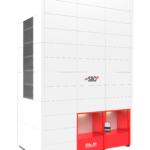
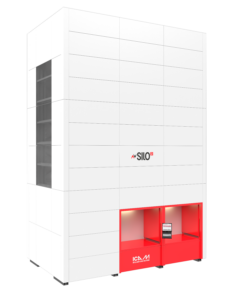
Vertical lift modules (SILO²)
A vertical lift module, or VLM, holds goods on shifting trays inside two facing columns, with a central lift that delivers trays to a picking station. ICAM’s SILO² can be configured with 2 to 7 columns and reach heights of up to 15 metres, with trays rated to 400 kg. It suits parts, tools, components and smaller stock, including dense items, handling specific loads from 113 up to 1,001 kg per square metre, which is unusual for this class of machine. Two versions are offered: a FAST model tuned for more than 30% higher hourly throughput, and an ECO model that cuts energy use by around 20%. Each unit can run 1 to 8 picking stations, so operators keep working while the next tray is prepared.
Automatic tower stores for panels and sheet metal (MAXI T)
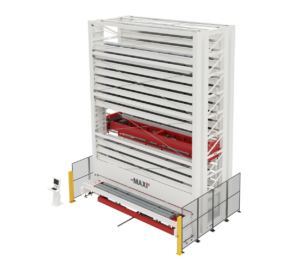
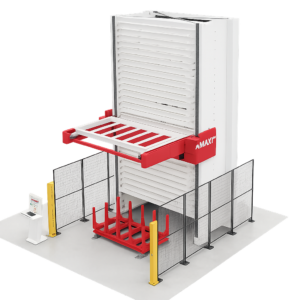
MAXI T is a tower system built for flat, bulky material such as sheet metal and panels. Drawers carry up to 3,000 kg each, the system as a whole handles up to 90 tonnes, and it reaches heights of up to 12 metres in single or facing dual tower layouts. Sheet metal shops use it to store blanks close to a laser or punch and feed them without manual lifting. A motorised shuttle delivers each drawer to the loading point on a support frame that a forklift can handle safely.
Automatic stores for long materials (MAXI L)
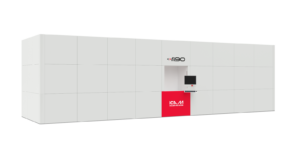
MAXI L is designed for long goods: bars, profiles, tubes, moulds and bundles up to 7,100 mm long. It uses drawers rated to 1,000 or 3,000 kg inside two facing towers, reaches up to 15 metres, and comes with open base or solid base drawers to suit the load. Aluminium and steel fabricators use it to store extrusions and feed cutting centres. Because it extends vertically in 500 mm modules, you can add height later as demand grows, which makes it a store that scales with the business rather than one you outgrow.
Stacker crane systems for high volume (MAXI STC)
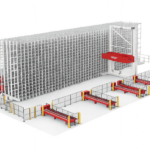
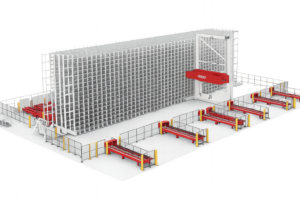
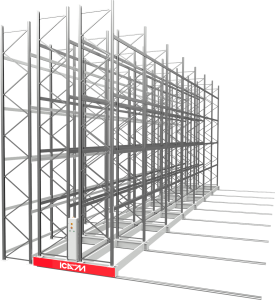
MAXI STC stores long materials too, up to seven metres, but it is built for intensive, high volume operations. Rather than drawers on a lift, it uses a stacker crane that runs the aisle and handles two load units at once on a fully automated cycle. ICAM positions it as the economical choice from around 400 load units upward, where continuous throughput matters more than drawer flexibility. On each trip it combines return and delivery into one movement, removing empty runs and lifting throughput, and it tracks every load unit by code, batch and order.
How to choose the right vertical storage system
Work through these six questions in order. The first one does most of the work.
1. Start with what you are storing
Material type is the single biggest factor, so settle it first. Small parts, tools and components point to a vertical lift module such as SILO². Flat panels and sheet metal point to a tower store such as MAXI T. Long bars, profiles and tubes point to either MAXI L or MAXI STC. Get this right and the shortlist almost writes itself.
2. Match the system to your volume and throughput
For long goods, the choice between MAXI L and MAXI STC comes down to scale. MAXI L, with its drawers, gives you flexibility and suits moderate volumes. MAXI STC, with its stacker crane and fully automated cycle, is built for high volume and becomes the sensible option from roughly 400 load units. If your pickers are constantly waiting on retrievals, that is a throughput problem, and it usually points to the crane.
3. Measure your building
Vertical systems only pay off if you have the height to use them. ICAM’s systems range from a few metres to 15 metres tall, so check your clear internal height, not just your floor area. All four are self supporting and built in steel, and all are rated for indoor or outdoor installation, which helps on sites where internal space is tight.
4. Think about how it feeds production
If the store exists to supply machines, integration matters as much as capacity. MAXI L and MAXI T are designed to feed cutting centres, presses, assembly lines and robots on a just in time basis, using fixed stations, motorised shuttles or automatic load ejectors. A system that drops material straight into your production flow removes a handling step that manual storage cannot.
5. Weigh control and traceability
Every ICAM system runs on ICON, the company’s warehouse software, which integrates with WMS and ERP platforms and tracks stock by item code, batch and order. If your customers or your industry demand batch and order traceability, this is not optional, and it is a strong reason to automate rather than store manually.
6. Do the floor space maths
Finally, put a number on the space you would recover and what it is worth. This is usually where the business case lives, and it is covered next.
How much floor space can you actually save?
The headline figures are large. ICAM reports up to 90% floor space reduction for the MAXI T tower and up to 90% surface saving for SILO², with around 80% of floor space recovered in typical layouts. Those numbers come from stacking upward what used to spread outward.
In Australia, that saving is worth more than in many markets, because industrial land and rent in the major capitals are expensive. Every square metre a machine hands back can be turned over to production, dispatch or a new line, rather than paid for and used to hold static stock. For many operators, the floor space return alone carries the investment, before any saving in labour or reduction in damaged stock is counted.
» MORE: See how SILO² recovers up to 80% of floor space
Australian considerations: standards, climate and delivery
Three local factors deserve attention before you commit.
Standards and safety. Automated storage in an Australian workplace sits under Work Health and Safety law, and steel storage racking design is covered by Australian Standard AS 4084. ICAM’s systems are built as guarded zones, with perimeter fencing, controlled access, light curtains and emergency stops that keep operators away from moving loads. Ask your supplier to confirm the compliance and certification documentation that applies to your installation.
Climate. The systems are rated as standard for 0 to 40°C and relative humidity of 50 to 85%, which covers most Australian sites. For hotter northern locations or outdoor installations, ICAM can supply components built to operate beyond those limits on request, so flag your conditions early.
Delivery and support. These are engineered systems manufactured in Italy, so lead time and local commissioning are real planning factors. This is where a local partner matters: SmartlogitecX handles specification, delivery and support for ICAM systems in Australia, which shortens the distance between a European factory and a working machine on your floor.
Common mistakes to avoid
A few errors come up again and again. The mistake we see most often is choosing on price.
Choosing on price alone. The cheapest system that does not fit your material or throughput is the most expensive decision you can make. Match the machine to the job first, then compare cost.
Ignoring integration. A store that cannot feed your machines leaves a manual handling step in place and undercuts the whole point of automating.
Under sizing throughput. Buying a drawer store when your volume calls for a stacker crane creates a new bottleneck at the picking station.
And one less obvious point: sometimes vertical storage is not the answer. If your stock volume is low, your range is static, or your footprint is genuinely small, conventional cantilever or pallet racking may deliver most of the benefit for far less money. Vertical systems earn their keep when floor space is scarce and costly, when manual retrieval is a real bottleneck, or when you need traceability that manual storage cannot provide.
The bottom line
Choosing a vertical storage system is simpler than it first looks, as long as you start in the right place. Settle what you store, then let volume, building height, production integration and traceability narrow the field. Parts and tools point to SILO². Sheet metal and panels point to MAXI T. Long materials point to MAXI L, or to MAXI STC once volume climbs. Get the material question right and the rest follows.
» MORE: Explore ICAM’s vertical storage systems
Frequently asked questions
What is a vertical storage system?
It is an automated store that stacks goods on trays, drawers or slots and uses a lift or crane to bring them to an operator at a picking station. It uses a building’s height and depth instead of only its floor, which cuts the space needed and removes most of the walking from picking.
What is the difference between a vertical lift module and a stacker crane?
A vertical lift module, such as SILO², moves trays up and down inside fixed columns and suits parts and components. A stacker crane, such as MAXI STC, runs along an aisle and handles long, heavy load units at high volume. In short, the lift module is about dense small parts storage, and the crane is about intensive throughput of long goods.
How much floor space can a vertical storage system save?
ICAM reports up to 90% floor space reduction on its tower systems and around 80% of floor space recovered with SILO². The exact figure depends on your ceiling height, product mix and current layout.
Which vertical storage system is best for long materials?
For bars, profiles and tubes, ICAM offers two options. MAXI L stores lengths up to 7,100 mm in drawers and suits moderate volumes. MAXI STC uses a stacker crane for lengths up to seven metres and high volume operations, and it becomes the economical choice from around 400 load units.
Can vertical storage systems be installed outdoors?
Yes. ICAM’s systems are self supporting, built in steel and rated for both indoor and outdoor installation. For sites beyond the standard 0 to 40°C and 50 to 85% humidity range, components can be supplied to operate beyond those limits on request.
How tall can a vertical storage system be?
It depends on the model. SILO² and MAXI L reach up to 15 metres, while MAXI T reaches up to 12 metres. Always check your clear internal building height before you specify a system.
Do vertical storage systems improve stock traceability?
Yes. ICAM systems run on ICON software, which tracks every item by code, batch and order and integrates with WMS and ERP platforms. That makes full traceability part of the storage process rather than a separate task.
Are vertical storage systems safe to operate?
They are designed as guarded, controlled zones. Depending on the system, that includes perimeter fencing, controlled access points, multi ray light curtains and emergency stop buttons that keep operators clear of moving loads. In Australia, confirm the relevant compliance and certification with your supplier.
How much does a vertical storage system cost?
Price is not published, because each system is configured to the job. The main cost drivers are size and height, the number of columns or towers, throughput, the number and type of picking stations, and installation. Ask your supplier for a quote based on your material, volume and building.
When is a vertical storage system worth the investment?
When floor space is scarce and expensive, when manual pick and retrieval is slowing production, or when you need batch and order traceability that manual storage cannot provide. If your volume is low and your stock is static, conventional racking may be the better value choice.